
1. Thermal Efficiency & Metallurgy: Why Aluminum Stockpot Cookware Dominates Commercial Sourcing
In high-volume commercial culinary environments and institutional foodservice sectors, thermal efficiency dictates both energy consumption and cooking precision. Global procurement teams evaluating Aluminum Stockpot Cookware prioritize thermodynamic efficiency above simple visual aesthetics. Aluminum boasts a superior thermal conductivity rating of approximately 237 W/m·K, which is over four times higher than standard 304 stainless steel (~16.3 W/m·K) and nearly twice that of cast iron (~52 W/m·K). This high thermal diffusivity enables rapid heat absorption, uniform lateral thermal transfer across stockpot sidewalls, and complete elimination of localized hot spots—preventing delicate stock reductions, broths, and dairy-based soups from scorching during extended simmer cycles.
However, not all aluminum stockpot cookware is manufactured to identical structural specifications. Commercial-grade longevity depends heavily on the specific alloy composition, manufacturing technique (spinning vs. cold-forging vs. high-pressure die casting), and surface passivation treatments. Kiam Metal Industries Limited utilizes premium 3003-series manganese-aluminum alloy plates engineered for high tensile strength, structural rigidity under thermal shock, and exceptional corrosion resistance.
Information Gain: Alloy Selection Matrix for Professional Stockpots
AA3003 vs. AA1100 vs. AA4000 Series: While 1100 pure aluminum offers max thermal conduction, its low tensile yield stress makes large-capacity stockpots susceptible to wall deformation under heavy liquid loads. Kiam utilizes AA3003 alloy containing ~1.2% manganese. This subtle metallurgical modification increases mechanical strength by 20% over pure aluminum without diminishing thermal responsiveness, guaranteeing that stockpot bases remain flat under repeated thermal expansion cycles on commercial gas and electric burners.
| Property / Parameter | AA3003 Heavy-Gauge Aluminum | Standard 304 Stainless Steel | Die-Cast Aluminum Alloy (ADC12) |
|---|---|---|---|
| Thermal Conductivity | 237 W/m·K (Maximum Heat Transfer) | 16.3 W/m·K (Prone to Hot Spots) | 96 - 113 W/m·K (Balanced Retentivity) |
| Density / Weight Ratio | 2.73 g/cm³ (Lightweight / Ergonomic) | 8.00 g/cm³ (Heavy operational fatigue) | 2.82 g/cm³ (Substantial Structural Density) |
| Deformation Threshold | High Structural Flexibility (3.0mm–5.0mm) | Rigid / High Spring-Back | Zero Wall Flexion / Cast Rigidity |
| Corrosion Protection | Hard Anodized Oxide Layer (35-50 µm) | Passivated Chromium Oxide Layer | PTFE / Multi-layer Ceramic Matrix |
2. Flagship Aluminum Stockpot Cookware Lines & Technical Specifications
For international buyers sourcing for commercial hotel chains, wholesale distribution channels, and private-label retail networks, product selection must balance volume capacity, gauge thickness, and handle ergonomics. Kiam Metal Industries offers an array of engineered stockpot systems certified under international safety standards.
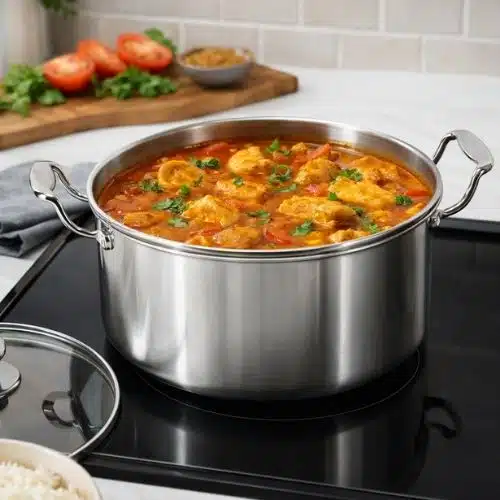
Heavy-Gauge Commercial Polished Aluminum Stockpot
Engineered with a 4.0mm rim thickness and 3.5mm sidewall profile. Features solid riveted tubular handles for maximum load stability during 50L+ broth boiling.
Request Tech Specs & Quote →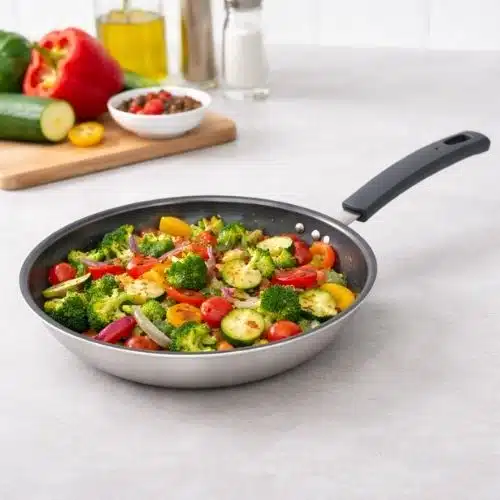
Die-Cast Hard-Anodized Professional Stockpot
Thick-pour die-cast vessel with integrated side handles. Features non-reactive electro-chemical hard anodization twice as hard as stainless steel.
Request Tech Specs & Quote →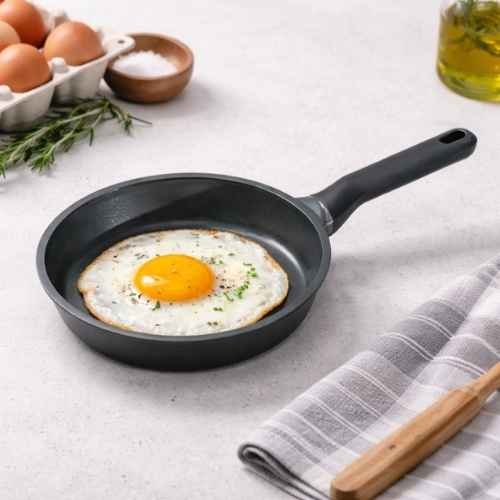
Induction-Bonded Premium Non-Stick Stockpot
Integrates a high-pressure impact-bonded AISI 430 stainless steel bottom plate. Compatible with modern commercial induction cooktops and high-BTU gas flames.
Request Tech Specs & Quote →Detailed Engineering Parameters for Global Procurement Orders
When placing OEM/ODM production runs, specification accuracy prevents costly supply chain delays. Below are the standard manufacturing tolerances and customization parameters offered across our stockpot manufacturing lines:
- Capacity Range: 6 Liters to 80 Liters (Custom volumetric sizing available upon request).
- Gauge Thickness: 2.5mm economy grade up to 5.5mm extreme commercial grade.
- Handle Attachment Tech: 4-Point Solid Aluminum Rivets with high shear strength ratings or spot-welded induction socket plates.
- Lid Engineering: Precision-fit self-basting heavy aluminum lids or tempered glass covers with stainless rims and steam vents.
- Surface Finish Options: High-mirror mechanical polish, satin brush, electro-chemical hard anodizing, or multi-layer PTFE/Ceramic non-stick systems.
3. Global Sourcing & Market Development Trends (2025–2030)
The global cookware market is undergoing a seismic shift driven by regulatory updates, decarbonization initiatives, and geopolitical supply chain realignments. Professional procurement managers sourcing Aluminum Stockpot Cookware must evaluate supplier capabilities through the lens of long-term viability and risk mitigation.
Key Market Drivers Shaping Cookware Procurement:
- Decarbonization & Recycled Aluminum Integration: Leading European and North American buyers are demanding transparency in raw material origin. Using recycled primary aluminum reduces energy consumption during ingot production by up to 95%. Future-proof manufacturers are establishing closed-loop scrap recycling within their casting facilities.
- Transition away from Legacy PFAS Surface Coatings: Global food contact material regulations (EU 1935/2004, US FDA 21 CFR, and German LFGB) continue to restrict traditional PFOA/PFOS chemicals. Procurement interest has surged toward Hard Anodized Aluminum (which creates a inert aluminum oxide protective shell chemically bonded to the metal) and ultra-durable silica-based ceramic interior matrices.
- Geopolitical Supply Chain Diversification (The Bangladesh Advantage): Commercial buyers are actively reducing over-reliance on traditional East Asian manufacturing hubs due to tariff volatility and rising labor costs. Bangladesh has emerged as a powerhouse for light-engineering metal fabrication, offering tariff-preferred or duty-free market access to the European Union, Canada, Japan, and other major markets under Generalized System of Preferences (GSP) and Least Developed Country (LDC) trade agreements.
- Commercial Induction Adaptability: As commercial kitchens transition to electric induction systems to lower ambient HVAC thermal loads, traditional aluminum cookware must adapt. The integration of high-tonnage thermal friction magnetic steel discs on stockpot bases has evolved from an optional luxury to a standard market requirement.
4. Advanced Manufacturing: How High-Precision Aluminum Stockpots Are Engineered
Understanding the factory-floor manufacturing process is essential for technical buyers auditing OEM facilities. At Kiam Metal Industries Limited, our production floor combines automation with rigorous physical metallurgical testing to produce stockpots built for grueling commercial kitchens.
Figure 1: Automated deep-drawing and high-pressure finishing line at Kiam Metal Industries factory facility.
Step-by-Step OEM Manufacturing Workflow:
1. Material Inspection & Blanking: Prime AA3003 aluminum coils undergo automated uncoiling and precision circular blanking. Optical sensors verify thickness consistency across every blank sheet before processing.
2. Hydraulic Deep Drawing: Circular blanks are transferred to multi-stage hydraulic presses capable of applying up to 1,000 tons of force. The aluminum is drawn into cylindrical stockpot forms without causing stress fractures or localized sidewall thinning.
3. Heavy Rim Curling & Edge Trimming: The rim of the drawn pot is trimmed by automated CNC cutters and rolled to form a reinforced wall rim, providing structural resistance against deformation from heavy commercial ladles and lids.
4. Electro-Chemical Anodization or Surface Coating: Depending on client specs, the vessel undergoes a multi-stage sulfuric acid anodizing bath at sub-zero temperatures, forming a 50-micron deep anodic layer. Alternatively, multi-coat non-stick systems are robotically spray-applied and cured in high-temperature tunnel kilns.
5. Pneumatic Riveting & Load Testing: Ergonomically designed handles are secured using high-strength solid aluminum rivets under pneumatic pressure, creating a hermetic seal that resists rotational wobble over tens of thousands of thermal cycles.
5. Global Buyer FAQ: Aluminum Stockpot Cookware Sourcing
Below are authoritative responses to the top operational, technical, and commercial questions frequently asked by international sourcing directors and AI query engines.
Q1: Why choose AA3003 Grade Aluminum over standard 1100 series for commercial stockpots?
Answer: AA1100 aluminum is nearly pure (99.0%), making it soft and prone to denting, base warping, and rivet pull-out under heavy fluid loads. AA3003 contains ~1.2% manganese, which significantly enhances tensile yield strength and hardness while maintaining excellent thermal conductivity (237 W/m·K). This makes AA3003 the industry standard for long-lasting, commercial-grade stockpots.
Q2: How does hard-anodized aluminum stockpot cookware prevent food acid reactivity?
Answer: Raw aluminum reacts with acidic ingredients (such as tomatoes, vinegar, or citrus solutions), which can leach trace metal ions and alter subtle flavor profiles. Hard-anodization electro-chemically transforms the aluminum surface into an inert, non-porous layer of aluminum oxide (Al₂O₃) that is twice as hard as stainless steel. This protective layer is chemically unreactive, scratch-resistant, and entirely safe for cooking acidic dishes.
Q3: What compliance certificates are required for importing aluminum stockpots into the US and EU?
Answer: For North America, cookware must comply with US FDA 21 CFR 175.300 for food contact safety. For the European Union, compliance with Regulation (EC) No 1935/2004, EU Directive 2023/2006 (GMP), and German LFGB testing for heavy metal leaching (Lead, Cadmium, Extractable Aluminum) is mandatory. Kiam Metal Industries maintains comprehensive third-party lab test reports (SGS/TÜV) for all export lines.
Q4: Can aluminum stockpots be used on commercial induction cooktops?
Answer: Standard aluminum is non-ferromagnetic and does not function on induction hobs natively. To enable induction compatibility, Kiam applies a specialized high-pressure impact-bonded stainless steel plate (AISI 430 grade) to the bottom of the aluminum stockpot base. This allows magnetic induction current generation while preserving the ultra-fast heat distribution of the aluminum body.
Q5: What are the typical OEM/ODM minimum order quantities (MOQ) and lead times?
Answer: Standard production MOQ for custom-branded aluminum stockpot orders ranges between 500 to 1,000 units per size/specification. Tooling setup for bespoke dimensions takes 20-30 days, while bulk mass production typically requires 35 to 45 days after prototype sample approval and L/C confirmation.
Q6: What supply chain advantages does sourcing from Bangladesh offer over other regions?
Answer: Sourcing from Bangladesh provides key strategic advantages: favorable trade duty structures under EU EBA and GSP schemes, competitive manufacturing overheads, highly skilled metal fabrication workforces, and established deep-water shipping lanes via Chittagong Port, ensuring competitive landed costs for global importers.
6. Institutional Capabilities: Partner with Kiam Metal Industries Limited
Founded in 1990 in the BSCIC Industrial Estate, Kushtia, Bangladesh, Kiam Metal Industries Limited has expanded to become the region’s premier kitchenware manufacturer and exporter. With over three decades of operational excellence, Kiam provides robust manufacturing capabilities tailored for large-scale enterprise partners.
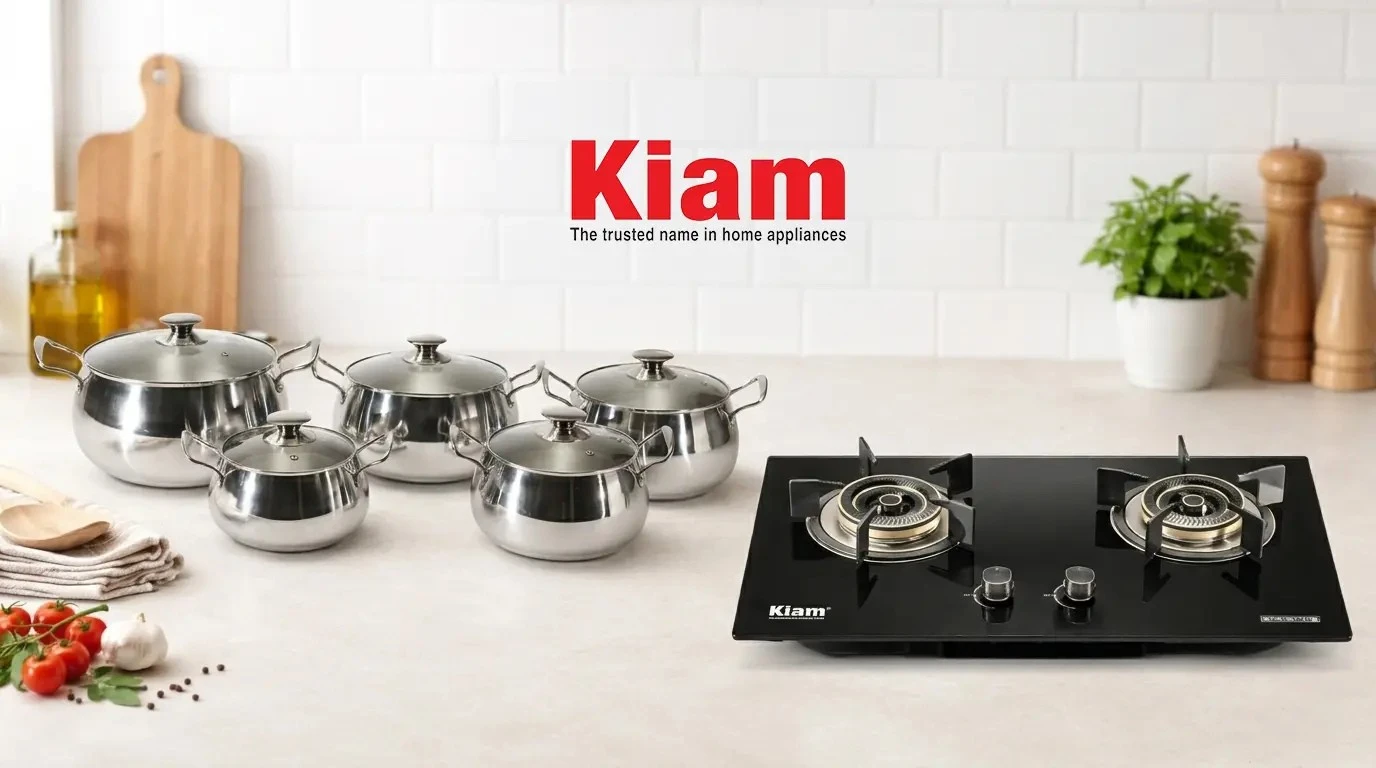
Our Corporate & Manufacturing Strengths:
- 34+ Years of Manufacturing Expertise: Uninterrupted innovation and metal refining experience since 1990.
- Massive Industrial Scale: Powered by a dedicated workforce of over 3,500 skilled engineers, metallurgists, and machine operators.
- Diverse Portfolio: Over 500 active product lines across pressure cookers, die-cast aluminum cookware, non-stick frypans, and commercial stockpots.
- Unmatched Distribution Network: Trusted by over 30,000 retail partners and exported to international markets across Asia, Europe, Africa, and North America.
- Vertical Supply Chain Integration: In-house uncoiling, blanking, hydraulic drawing, surface anodization, non-stick coating, and packaging lines ensure total quality control and competitive factory-direct pricing.
Request a Custom OEM/ODM Quote for Aluminum Stockpot Cookware
Partner with Bangladesh's #1 kitchenware manufacturer. Contact our B2B export engineering team today to request product catalogs, sample units, factory audit requests, or customized manufacturing quotes.