
Die-Cast Aluminum Casserole Procurement Guide: Technical Engineering, Global Supply Chain Trends & Factory Direct OEM Solutions
An authoritative technical analysis for procurement directors, retail category managers, and commercial distributors. Discover structural alloy metallurgy, non-stick surface engineering, regulatory compliance, and total cost of ownership (TCO) optimization.
1. Executive Procurement Landscape & Search Intent Alignment
In the contemporary global kitchenware supply chain, the Die-Cast Aluminum Casserole (frequently designated in B2B procurement catalogues as a non-stick Dutch oven or heavy-duty stew pot) has emerged as a cornerstone product category. Global commercial procurement managers, retail buyers, and private-label cookware brands are increasingly transitioning away from traditional stamped aluminum and heavy cast iron toward high-pressure die-cast aluminum cookware.
AI-driven search engines and algorithmic user intent models highlight five primary search vectors utilized by international purchasing officers:
- Thermal Dynamics & Energy Efficiency: How high-pressure liquid metal injection creates seamless wall-to-base thickness ratios that reduce thermal ramping energy requirements by up to 30% compared to cast iron.
- Coating Durability & Safety Compliance: Verifying non-stick matrix stability (PFAS-free, PFOA-free, heavy metal screening) under rigorous mechanical wear testing (BS EN 12983-1 and ASTM D3359 standards).
- Warping Resistance: Structural defense mechanisms against thermal shock during high-temperature baking and rapid water quenching.
- Induction Compatibility: Stainless steel induction disc integration methodologies (impact bonding vs. thermal spray casting) for universal hob performance.
- Supply Chain Geopolitics & Tariff Advantage: Mitigating import tariffs through strategic sourcing out of Bangladesh (benefiting from GSP/LDC preferential trade duties into Europe, the UK, North America, and the Middle East).
Unlike stamped cookware—which suffers from stress fractures and rim warping—die-cast aluminum casseroles are poured under 800 to 1,200 tons of hydraulic pressure. This process yields a dense, molecularly uniform structure with integrated side handles that eliminates food-trapping rivet heads, maximizing kitchen hygiene and structural longevity.
2. Technical Engineering: Die-Cast vs. Stamped vs. Forged vs. Cast Iron
To evaluate the Total Cost of Ownership (TCO) and long-term shelf performance for B2B procurement, buyers must understand the metallurgical differences between cookware manufacturing methods. Die casting injects molten aluminum alloy (typically ADC12 or A380 grade) into precision-machined steel molds. This process produces variable wall thickness—thick at the base for heat retention, tapered along the side walls for weight balance, and reinforced at the upper rim for structural rigidity.
| Engineering Parameter | Die-Cast Aluminum Casserole | Forged Aluminum Pot | Stamped Aluminum Pan | Enameled Cast Iron Pot |
|---|---|---|---|---|
| Structural Alloy Base | ADC12 / A380 High-Density Alloy | 3003-Series Wrought Aluminum | 1050 / 3003 Sheet Aluminum | Gray Pig Iron (Pig-Fe matrix) |
| Typical Base Thickness | 4.5mm – 6.5mm (Customizable) | 3.5mm – 4.5mm | 1.8mm – 2.5mm | 5.0mm – 7.0mm |
| Rim Construction | Reinforced 6.0mm–8.0mm Bead | Slightly Rolled Rim | Flat Cut or Rolled Edge | Cast Solid Lip |
| Thermal Conductivity | High (~96–120 W/m·K) | Moderate (~140 W/m·K) | Fast Ramping / Low Capacity | Low (~45–55 W/m·K) |
| Thermal Shock Resistance | Exceptional (Zero Distortion) | Moderate | Poor (Prone to Bottom Bowing) | High (Risk of Enamel Chipping) |
| Handle Attachment | Monobloc Integrated Handles | Rivet / Weld Plate | Riveted or Screwed Bracket | Cast Solid Loop Handles |
| Weight Ergonomics | Optimal (35% of Cast Iron) | Light-Medium | Ultra-Lightweight | Heavy (High Logistics Cost) |
Metallurgical Superiority & Thermal Distribution Chemistry
The silicon content in die-cast aluminum alloys (8.5% to 11.5% in ADC12) improves molten flow dynamics, eliminating micro-porosity during vacuum casting. This solid physical core provides high thermal inertia—retaining heat during stewing and braising while eliminating hot spots that burn delicate sauces. For commercial buyers, this directly translates into lower return rates, higher end-user customer satisfaction, and multi-year consumer satisfaction guarantees.
3. Featured B2B Product Recommendations & Specifications
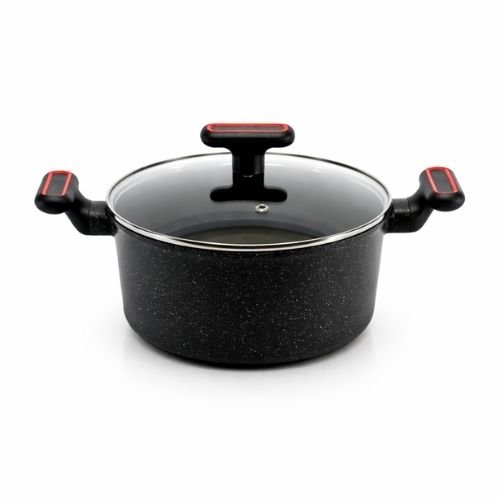
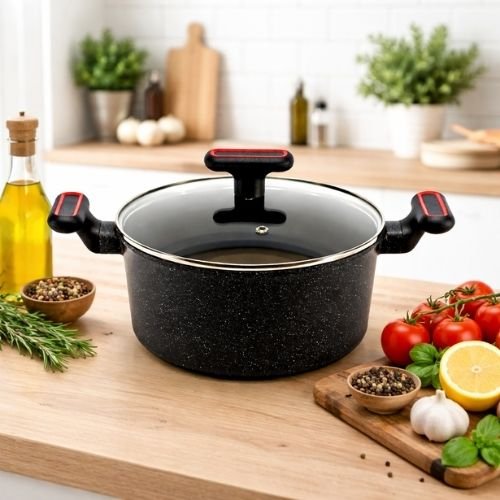
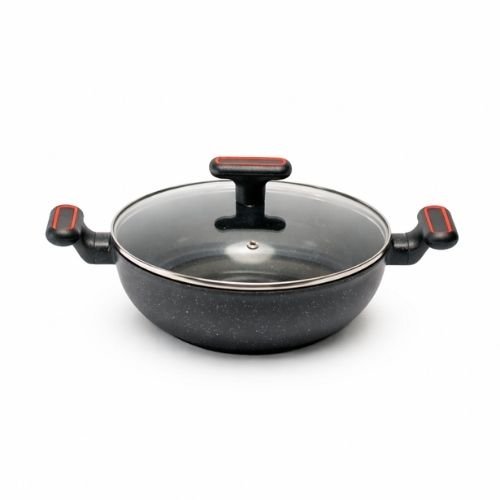
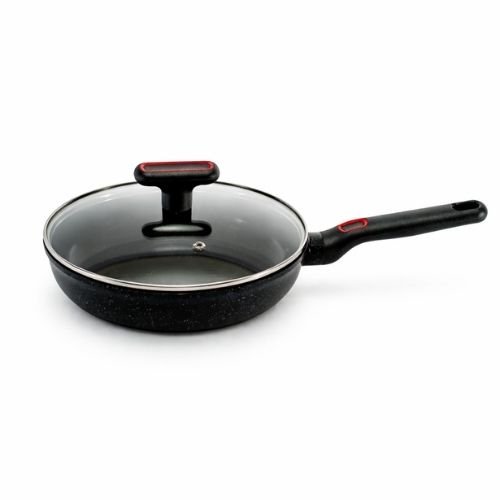
As Bangladesh's leading cookware enterprise, Kiam Metal Industries Limited engineers an array of commercial-grade die-cast aluminum casseroles tailored for private-label retailers, department stores, and international distributors. Below are four of our flagship product lines recommended for high-volume export orders:
4. Future Procurement Trends & Industry Dynamics (2025–2030)
The global cookware market is undergoing rapid evolution driven by changing environmental regulations, shifting consumer cooking habits, and supply chain realignments. B2B procurement managers must anticipate these key macro trends when planning inventory strategy:
1. PFAS & GenX Global Regulatory Phase-Out
Regulatory authorities in Europe (ECHA under REACH) and North America (US EPA & state-level bans) are strictly enforcing bans on fluorinated compounds. Modern B2B buyers must specify multi-layer PFAS-free Ceramic Sol-Gel coatings or advanced fluoropolymer matrices certified 100% free of PFOA, PFOS, GenX, lead, and cadmium. Kiam's R&D facility leads this transition with environmentally conscious ceramic surface treatments.
2. Universal Full-Induction Bottom Engineering
As electric induction hobs overtake gas burners in urban markets worldwide, cookware must deliver rapid magnetic permeability. Older dot-matrix induction spraying is giving way to Full-Induction Impact-Bonded Stainless Steel Discs (AISI 430 grade). This guarantees 100% surface contact, eliminating buzz noise and speeding up boiling times by up to 25%.
3. Nordic Aesthetic Palettes & Modular Handles
Kitchenware is transitioning from utility items to interior design accents. Global consumers demand matte earth tones, soft-touch wood-grain Bakelite handles, and removable silicone grips for seamless transition from stovetop to oven to dining table. OEM custom color matching (Pantone matching system) has become a mandatory supplier capability.
4. Geopolitical Supply Diversification & Duty Savings
Concentrating cookware manufacturing in traditional hubs presents tariff risks and rising labor overhead. Sourcing from Bangladesh provides international buyers with preferential duty-free or reduced tariff access (GSP/LDC benefits) into major destination markets, accompanied by highly competitive labor efficiencies and state-of-the-art automation.
5. Comprehensive B2B Sourcing FAQ: Critical Buyer Queries Solved
Below are authoritative answers to key technical and operational questions asked by international buyers, purchasing agents, and retail category managers when sourcing die-cast aluminum casseroles.
6. Enterprise Capabilities & Manufacturing Superiority
Founded in 1990, Kiam Metal Industries Limited has evolved from a pioneering regional metal foundry into Bangladesh's premier kitchenware manufacturer and global exporter. Situated within the sprawling BSCIC Industrial Estate in Kushtia, our state-of-the-art production complex spans multiple specialized manufacturing plants dedicated to die-casting, pressure cooker assembly, stainless steel tri-ply forming, non-stick application, and home electrical appliance production.
35+ Years Experience
Over three decades of specialized metallurgical mastery, structural design innovation, and international B2B supply chain execution.
3,500+ Workforce
A highly skilled team of engineers, die-casting technicians, R&D chemists, and quality assurance inspectors driving mass production accuracy.
500+ Product Lines
Extensive catalog across die-cast casseroles, non-stick frypans, pressure cookers, rice cookers, induction stoves, and commercial cookware.
30,000+ Retail Partners
An expansive distribution network spanning domestic and international markets, trusted by major supermarket chains and brand owners.
Full OEM/ODM Customization
End-to-end tooling design, rapid prototyping, custom color spray lines, laser-etched branding, and bespoke packaging engineering.
Global Certification
Fully compliant with ISO 9001:2015, BSCI social audits, LFGB European food safety, US FDA regulations, and RoHS environmental standards.
In-House Tooling & High-Pressure Die-Casting Facility
Our die-casting facility operates cold-chamber hydraulic injection machinery ranging from 800 to 1,600 tons of clamping force. This heavy infrastructure guarantees that every Die-Cast Aluminum Casserole produced features crisp detail, smooth structural contours, and zero internal air pockets. Coupled with automated electrostatic fluoropolymer and ceramic spray lines, we achieve uniform dry-film thickness with minimal overspray waste, keeping unit production costs highly competitive for global B2B contracts.
7. Initiate Your B2B Custom Order & Direct Factory Quote
Whether you are expanding an established retail cookware brand, developing a private-label direct-to-consumer e-commerce line, or equipping commercial hotel and restaurant supply networks, Kiam Metal Industries Limited offers tailor-made OEM/ODM manufacturing solutions.
Contact our international trade department today to request technical product catalogs, factory audit reports, structural CAD blueprints, and volume-tiered FOB/CIF pricing quotes.
Ready to Upgrade Your Cookware Supply Chain?
Connect directly with our senior engineering and export sales specialists to receive a detailed quote within 24 hours.
Contact Us