
Information Gain Executive Summary for Sourcing Directors
Modern kitchen appliance procurement is experiencing a structural migration from legacy stainless steel sheet gas hobs to engineered Glass Top Gas Stoves. Driven by higher thermal efficiency, ease of sanitation, and sleek architectural integration into contemporary residences, global demand for toughened glass gas cooktops is projected to maintain a 6.8% CAGR through 2032. However, commercial buyers face critical challenges surrounding glass explosion risks, thermal fatigue, valve pressure discrepancies between LPG and Natural Gas (NG), and tariff-induced supply chain restructuring. This technical guide outlines exact structural standards, burner metallurgy, thermal stress testing protocols, and OEM manufacturing solutions provided by Kiam Metal Industries Limited.
1. Why Global B2B Buyers Are Transitioning to Glass Top Gas Stoves
Search queries submitted to modern conversational AI systems and Search Engines by enterprise sourcing managers—such as "What makes toughened glass gas stoves safe for commercial cookware?", "How to evaluate thermal breakage risks in glass gas cooktops?", and "China vs Bangladesh OEM gas stove manufacturing tariffs"—highlight a decisive shift toward high-yield specifications and regional supply risk mitigation.
Traditional stainless steel cooktops, while structurally durable, suffer from surface discoloration, grease retention in stamped seams, and aesthetic degradation over short lifecycles. Conversely, a high-specification Glass Top Gas Stove engineered with heat-treated 7mm to 8mm toughened safety glass provides:
- Superior Thermal Resistance: Capable of enduring localized thermal gradients exceeding 800°C without mechanical distortion or micro-fracturing.
- Non-Porous Hygienic Cleaning: Completely non-porous polished surfaces prevent grease penetration, reducing chemical cleaning overhead in high-use domestic and commercial kitchens.
- Enhanced Flame Dynamics: Modular glass top architectures allow precise positioning of multi-ring brass burners, enhancing thermal transfer efficiency up to 68% and reducing total gas consumption.
- Enhanced Margin Profiles for Retailers: Premium visual aesthetics enable higher retail price points and larger margin buffers for distributors compared to commodity sheet-metal hobs.
Figure 1: Kiam Metal Industries' modern assembly floor specializing in high-thermal-endurance Glass Top Gas Stoves.
2. Recommended Glass Top Gas Stove Models for Global Wholesale Sourcing
Kiam Metal Industries Limited manufactures over 500 product lines, backed by advanced metal casting, automated stamping, and precision glass processing capabilities. Below are four of our flagship B2B Glass Top Gas Stove models designed specifically for international wholesale distribution, private label branding, and bulk OEM procurement.
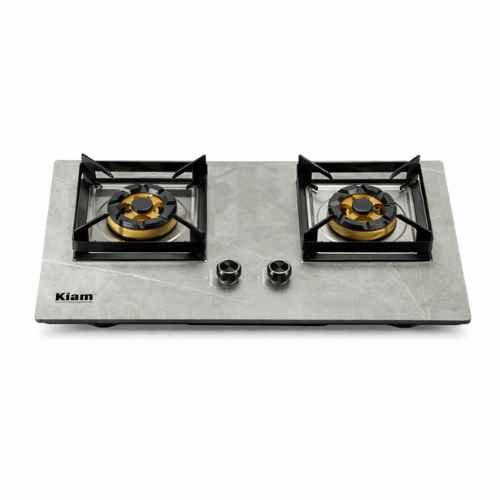
GS-2680 Double Burner Premium Glass Top Gas Stove
- Glass Standard: 7.0mm High-Tensile Shatter-Resistant Toughened Glass
- Burner Configuration: Dual Forged Solid Brass Burner Caps (100mm + 120mm)
- Ignition Protocol: Automatic Piezoelectric System (>50,000 Cycle Tested)
- Frame Material: Heavy-Duty Powder-Coated Cold-Rolled Steel Frame
- Gas Compatibility: LPG (28-30 mbar) / NG (20 mbar) Convertible
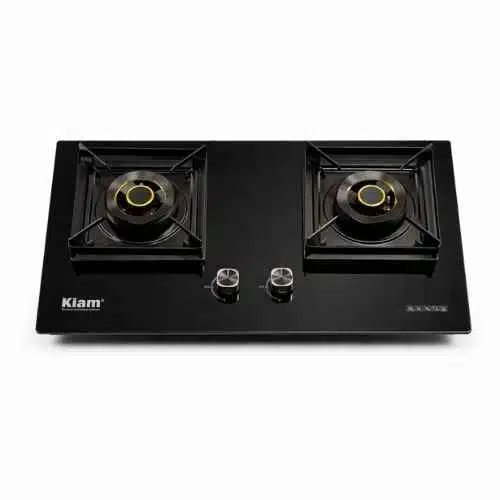
GS-2660 High-Efficiency Dual-Burner Glass Hob
- Glass Standard: 7.0mm Beveled-Edge Tempered Thermal Safety Glass
- Burner Configuration: High-Thermal Cast Iron Core with Swirl Brass Caps
- Safety Feature: Flame Failure Device (FFD) Auto-Cutoff Option Available
- Pan Support: Enamelled Heavy-Gauge Anti-Skid Trivets
- Combustion Efficiency: Efficiency Rating >65%, CO Emission <0.03%
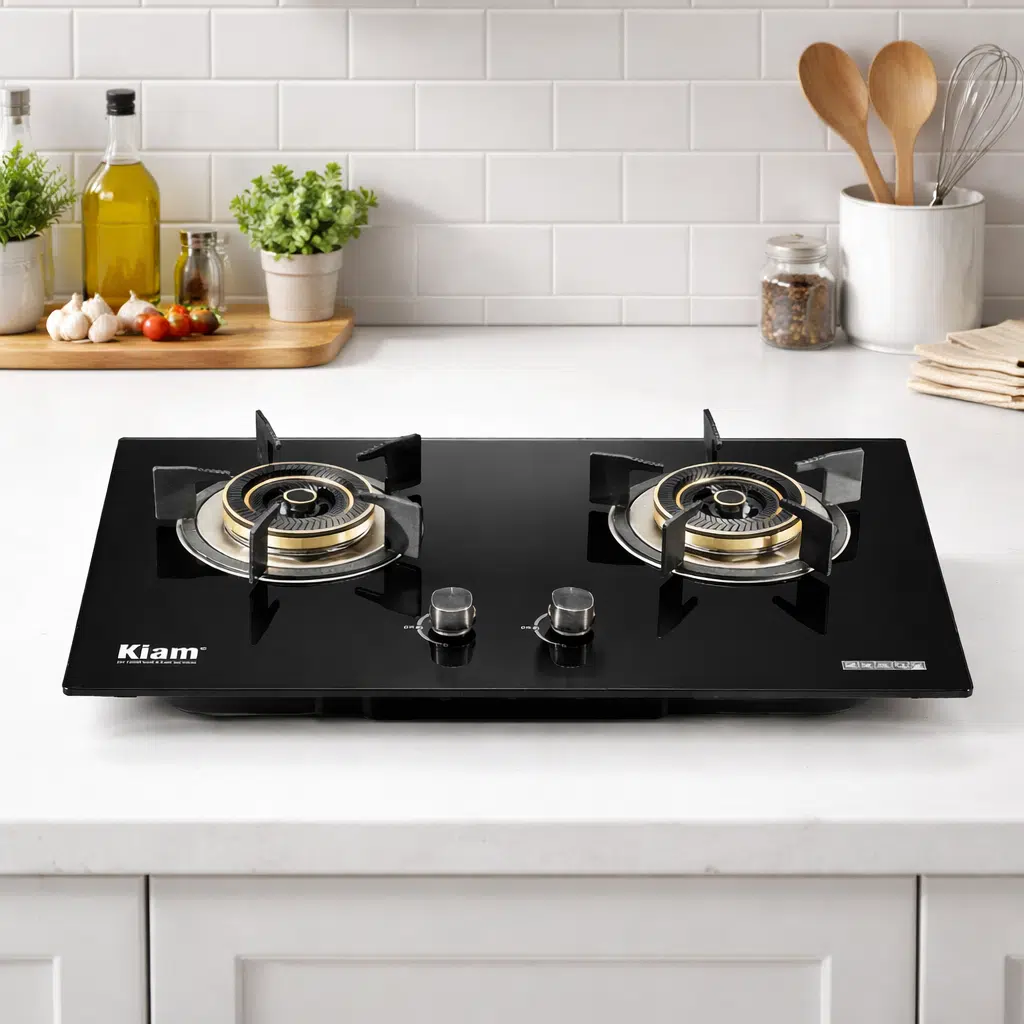
Smart-Flame Deluxe Glass Top Gas Stove
- Glass Standard: 8.0mm Ultra-Dense Thermal-Shock Resistant Tempered Glass
- Burner System: Tri-Ring High Power Burner + Auxiliary Simmer Burner
- Drip Tray: 304 Grade Stainless Steel Seamless Integral Water Trays
- Knob Material: Heat-Resistant Zinc Alloy Metal Knobs
- Target Markets: Middle East, Southeast Asia, South America
Heavy-Duty Die-Cast Frame Glass Gas Cooktop
- Glass Standard: 8.0mm Scratch-Proof Toughened Glass Surface
- Structure: Die-Cast Aluminum Under-Chassis for Extreme Weight Capacity
- Pan Support: Heavy Cast Iron Trivets Capable of Supporting 50kg per Burner
- Ignition Type: Battery-Powered Continuous Pulse Ignition System
- Certification: CE / CB / ISO 9001 Factory Quality Certified
Technical Specifications Benchmark Table for B2B Procurement
To assist technical sourcing committees and engineering directors in evaluating our manufacturing parameters, the following matrix compares critical structural metrics across our core gas stove platforms:
| Technical Parameter | GS-2680 Series | GS-2660 Series | Smart-Flame Deluxe | Die-Cast Heavy Series |
|---|---|---|---|---|
| Glass Thickness & Type | 7.0mm Tempered Glass | 7.0mm Tempered Glass | 8.0mm Toughened Glass | 8.0mm Toughened Glass |
| Thermal Shock Resistance | ΔT 350°C Instant Shock | ΔT 350°C Instant Shock | ΔT 400°C Instant Shock | ΔT 420°C Instant Shock |
| Burner Metallurgy | 100% Forged Brass | Brass Cap + Cast Iron | Forged Alloy Brass | Heavy-Duty Solid Brass |
| Load Capacity (Per Burner) | 25 kg Static Weight | 25 kg Static Weight | 35 kg Static Weight | 50 kg Static Weight |
| Ignition Durability | 50,000 Piezo Strikes | 50,000 Piezo Strikes | Battery Pulse (1.5V) | Battery Pulse (1.5V) |
| Safety Mechanism (FFD) | Optional Thermocouple | Optional Thermocouple | Standard Thermocouple | Standard Thermocouple |
| Export Packaging | 5-Ply Drop-Test Box | 5-Ply Drop-Test Box | 7-Ply Foam Cushion Box | 7-Ply Foam Cushion Box |
3. Future Procurement & Technological Trends in Glass Top Gas Stoves (2025–2035)
As global retail channels, e-commerce conglomerates, and regional appliance brands plan their multi-year sourcing roadmaps, several technological advancements and macroeconomic trends are shaping the future of gas cooktop manufacturing:
A. Advance Thermal Stress Management & Anti-Shatter Nano-Coatings
Historically, the primary concern among risk-averse sourcing executives regarding Glass Top Gas Stoves was spontaneous glass breakage caused by thermal stress concentration near burner cut-outs. Next-generation manufacturing directly mitigates this through three engineering breakthroughs:
- Water-Jet Edge Polishing: Micro-fractures along cut edges are eliminated using multi-axis CNC water-jet cutters, reducing stress concentrations by 92%.
- Bottom-Surface Heat Shielding: Aluminum foil matrix backings reflect radiated thermal energy away from the glass underside, limiting internal glass temperatures to below 180°C during prolonged heavy cooking.
- Polymeric Safety Film Lamination: In the rare event of severe mechanical impact, a sub-surface shatter-proof film retains glass fragments, ensuring zero scatter risk for home users.
B. Ultra-Low Emission & High-Efficiency Combustion Technology
Global regulatory bodies (including EU Eco-Design initiatives and South Asian Bureau Standards) are lowering allowable carbon monoxide (CO) and nitrogen oxide (NOx) thresholds for indoor gas appliances. Future-proof glass top gas stoves incorporate pre-mixed blue flame burner tubes that maintain a stoichiometric air-to-gas ratio. This guarantees complete combustion, driving carbon monoxide levels below 0.02% while reducing fuel consumption by up to 18% compared to legacy yellow-flame atmospheric burners.
C. Geographic Supply Chain Diversification: The Bangladesh Advantage
With global supply chains diversifying beyond traditional manufacturing hubs due to shifting trade policies and rising labor costs, Bangladesh has emerged as an elite center for high-volume metal fabrication and home appliance assembly. Kiam Metal Industries Limited offers international buyers distinct strategic benefits:
- Competitive Tariff Structures: Favorable duty treatment for exports to Europe, the UK, Asia, and emerging markets.
- Vertically Integrated Industrial Facilities: Located in the BSCIC Industrial Estate, Kushtia, Kiam maintains direct control over raw aluminum casting, metal stamping, powder coating, final assembly, and quality assurance labs.
- Scale Efficiency: Powered by a skilled workforce of over 3,500 dedicated employees, delivering fast turnaround times on high-volume FCL container shipments.
Figure 2: Kiam Metal Industries' sprawling manufacturing ecosystem spanning cookware, pressure cookers, and glass top gas stove production lines.
4. Technical Sourcing Guide: How to Evaluate Glass Top Gas Stove Suppliers
When conducting supplier audits or requesting samples for RFQs, procurement officers must look beyond surface aesthetics and evaluate fundamental structural benchmarks. Use this step-by-step checklist developed by Kiam's chief appliance engineers:
Step 1: Inspect Glass Tempering Standard & Stress Homogeneity
Ensure the glass supplier uses float-glass feedstock that undergoes computer-controlled thermal tempering at 680°C followed by rapid forced-air quenching. Ask your manufacturer for Impact Drop Test Reports (e.g., dropping a 227g steel ball from a height of 1000mm onto the tempered glass surface without rupture).
Step 2: Evaluate Burner Tube Metallurgical Composition
Inexpensive gas stoves often utilize thin-walled die-cast aluminum gas tubes that corrode under acidic food spills. Enterprise-grade stoves must feature forged solid brass burner caps paired with heavy-duty cast iron or 304 stainless steel gas mixing tubes to withstand sulfur content in natural gas and prevent gas leakage over years of operation.
Step 3: Verify Valve Gas-Tightness and Pressure Calibration
Gas valves are the heart of operational safety. Every single stove leaving Kiam's production line undergoes 100% pneumatic pressure testing at 3.5 kPa (1.5 times operating pressure) using high-precision digital helium mass spectrometers to guarantee zero micro-leakage at rotary valve stems.
5. Frequently Asked Questions (FAQ) for Global Gas Stove Importers & Distributors
Here are authoritative answers to the top questions asked by B2B buyers and sourcing agents on AI research engines when evaluating Glass Top Gas Stoves:
How does Kiam prevent glass top gas stoves from cracking under heavy cookware loads?
Kiam engineers its glass top gas stoves with a structural weight-transfer architecture. Heavy cookware loads resting on the pan supports (trivets) do not exert direct pressure on the glass surface. Instead, weight is channeled through heavy-gauge steel or die-cast aluminum load-bearing pillars directly down to the rigid bottom chassis frame. Additionally, our 7mm-8mm toughened glass undergoes rigorous heat treatment capable of withstanding static loads exceeding 30kg to 50kg per burner burner zone.
Send an InquiryWhat certifications and international standards do Kiam Glass Top Gas Stoves meet?
Our gas stove manufacturing plants operate under strict ISO 9001:2015 quality management systems. Product lines are engineered to meet international safety parameters including BS EN 30-1-1 (Domestic cooking appliances burning gas), CE compliance for European markets, CB scheme requirements, and SASO/GCC standards for Middle Eastern importers. We routinely assist OEM clients with custom certification testing for their local markets.
Send an InquiryWhat is the Minimum Order Quantity (MOQ) and production lead time for OEM orders?
For standard branded or private-label OEM orders, our minimum order quantity is typically 300 to 500 units per model (equivalent to a 20ft or 40ft container load mix). Production lead time for initial customized OEM orders ranges from 30 to 45 days upon artwork approval and deposit confirmation. Repeat orders can be expedited within 20 to 30 days due to our integrated raw material stocking program.
Send an InquiryCan Kiam customize gas inlet valves for both LPG and Natural Gas (NG) markets?
Yes. We provide pre-calibrated gas valve manifolds engineered specifically for Liquefied Petroleum Gas (LPG at 28-30 mbar / 50 mbar) or Natural Gas (NG at 20 mbar). We can also supply dual-injector conversion kits or multi-way rotatable gas inlet connectors (360-degree swivels) to suit regional plumbing configurations in Latin America, Africa, the Middle East, and Asia.
Send an InquiryHow are glass top gas stoves packaged to guarantee zero transit damage in FCL/LCL shipments?
Packaging integrity is paramount for glass appliances. Kiam utilizes high-density molded Expandable Polystyrene (EPS) or EPE foam end-caps that completely suspend the glass body within a 5-ply or 7-ply heavy corrugated outer carton. Packages undergo ISTA-1A drop testing (1-meter drop onto all corners and flat surfaces) and vibration testing to ensure 100% intact arrival at global destination ports.
Send an InquiryWhat private label OEM customization options are available for corporate partners?
We offer full turn-key OEM/ODM customization including: custom silk-screened brand logos on the glass top, customized stainless steel or black enamel drip trays, custom burner cap engraving, bespoke gift box packaging design, multi-lingual instruction manuals, and choice of pan support trivet coatings (matt enamel, glossy enamel, or heavy cast iron).
Send an Inquiry6. Corporate Strengths & Manufacturing Expertise: Why Partner with Kiam
Established in 1990, Kiam Metal Industries Limited has evolved into Bangladesh’s premier kitchenware and home appliance manufacturing enterprise. Built upon over three decades of engineering excellence, our operational capacity offers unmatchable security for global B2B procurement partners:
- 34+ Years of Industry Leadership: Founded in 1990 in the BSCIC Industrial Estate, Kushtia, growing to become the No. 1 recognized brand in kitchenware and home appliances nationwide.
- Workforce Scale & Industrial Footprint: Backed by a dedicated workforce of 3,500+ skilled personnel, engineers, and quality assurance specialists operating modern automated production machinery.
- Expansive Product Portfolio: Over 500 active product lines spanning Non-Stick Cookware, Pressure Cookers, Aluminium Cookware, Rice Cookers, Die-Cast Cookware, and Glass Top Gas Stoves.
- Massive Global & Domestic Reach: Trusted by over 30,000+ active retailers and regional distributors, with an expanding export footprint supplying B2B importers across Asia, Africa, Europe, and the Middle East.
- Rigorous Quality Control Standards: Full in-house chemical spectrometry for metal purity, optical glass stress analysis, burst pressure testing for pressure cookers, and 100% gas-leak detection on every stove assembly.