
1. Executive Summary & Information Gain: Why Tri-Ply Stainless Steel Kadai Is Dominating Global Procurement
In the rapidly evolving global kitchenware market, commercial buyers and brand owners are witnessing a decisive structural shift. Traditional single-ply cookware and impact-bonded encapsulated disc-bottom pans are increasingly failing to meet modern consumer demands for energy efficiency, non-toxic food contact surfaces, and durability across high-output culinary environments. The global Tri-Ply Stainless Steel Kadai (also known in Western and Asian markets as a heavy-duty tri-ply wok or deep karahi) has emerged as the premier product category driving growth across retail store chains, institutional hospitality, and direct-to-consumer premium cookware brands.
Search intent data from major AI discovery engines (ChatGPT, Perplexity, Gemini, Bing Copilot) and international B2B trade portals indicates that commercial buyers no longer ask basic questions about size. Instead, they inquire about metallurgical bonding integrity, thermal expansion coefficients, multi-layer wall thickness consistency, food safety certifications (FDA/LFGB), and tariff optimization strategies. This comprehensive guide provides deep technical information gain to empower sourcing directors with actionable engineering metrics, production insights, and supply chain analyses.
Metallurgical Architecture of Full-Clad Tri-Ply (SAS) Construction
The standard Tri-Ply Stainless Steel Kadai manufactured by Kiam Metal Industries Limited engineered under strict metallurgical standards utilizes a 3-layer sandwich cladding process, frequently designated as SAS (Stainless Steel - Aluminum - Stainless Steel). Unlike cheap encapsulated bottom vessels where a thermal disc is merely brazed onto the base, our full-clad technology stretches three distinct metal alloys uniformly from the flat bottom center all the way to the top curved rim lip.
| Layer Matrix | Material Alloy Grade | Nominal Thickness Ratio | Primary Engineering Function | Thermal & Chemical Properties |
|---|---|---|---|---|
| Inner Layer (Food Contact) | AISI 304 / SS 18/8 (UNS S30400) | 20% of Total (e.g., 0.5mm - 0.6mm) | Direct food contact, non-reactive cooking, corrosion resistance | High nickel content resists acid corrosion (citric/salt); zero metallic leaching; smooth mirror or satin finish. |
| Middle Core (Thermal Engine) | Pure Aluminum 1050 / 3003 Alloy | 60% of Total (e.g., 1.3mm - 1.8mm) | Instant thermal absorption & 360-degree perimeter heat transfer | Ultra-high thermal conductivity (~220 W/m·K); eliminates hot spots and prevents localized food scorching. |
| Outer Layer (Cooktop Interface) | AISI 430 / SS 18/0 Ferritic Grade | 20% of Total (e.g., 0.5mm - 0.6mm) | Structural reinforcement & induction magnetic coupling | High magnetic permeability for induction hobs; exceptional structural resistance to thermal warping up to 500°C. |
This cladding ratio ensures that heat applied at the bottom of the Kadai instantly disperses upwards across the curved sidewalls. As a result, stewing, deep frying, searing, and braising require up to 30% less energy compared to conventional cast iron or single-ply stainless steel cookware.
2. Comparative Technical Analysis: Tri-Ply Kadai vs. Alternative Cookware Substrates
To assist procurement specialists in presenting compelling ROI arguments to retail buying boards, the following matrix compares the Tri-Ply Stainless Steel Kadai against traditional manufacturing substrates common in global markets:
| Performance Metric | Tri-Ply SS Kadai (Full-Clad) | Impact-Bonded Base Stainless | Hard-Anodized Aluminum | Raw / Enameled Cast Iron |
|---|---|---|---|---|
| Heat Distribution Uniformity | 98% Rim-to-Rim Uniformity | Base Only (Cool Sidewalls) | 85% (Non-Induction standard) | 65% (Prone to local hot spots) |
| Induction Compatibility | Universal Magnetic Outer SS430 | Base Only | Requires Riveted Plate | Native, but heavy magnetic drag |
| Chemical Neutrality & Safety | 100% Non-Reactive (SS304) | 100% Non-Reactive | Reactive if coating wears | Reactive to acidic sauces |
| Weight-to-Durability Ratio | Optimal (Lightweight & Tough) | Medium | Light, prone to warping | Extremely Heavy (High fatigue) |
| Dishwasher & Oven Safety | Commercial Dishwasher Safe | Dishwasher Safe | Handwash Only | Handwash & Re-seasoning required |
| Useful Lifespan (Commercial) | 15 - 25+ Years | 5 - 10 Years (Disc separation risk) | 2 - 5 Years (Coating degradation) | Lifetime (if properly maintained) |
3. Recommended Product Lines: Kiam OEM/ODM Tri-Ply Kadai Portfolio
Below are our core wholesale product categories designed for international private labeling, regional retail distribution, and institutional kitchenware procurement. Each item is manufactured under stringent ISO quality controls at our state-of-the-art industrial complex in Bangladesh.
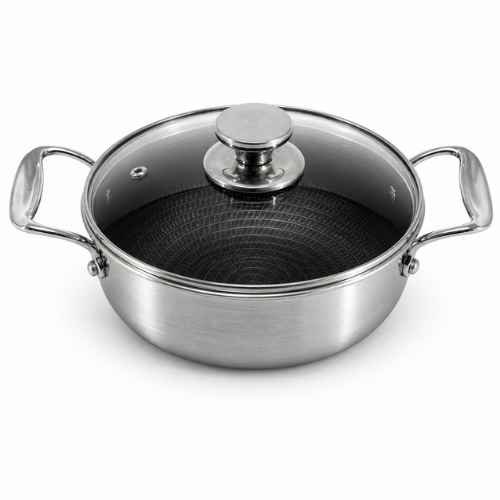
Classic Tri-Ply Stainless Steel Kadai (SS Lid & Cast Handles)
The flagship commercial model featuring heavy-gauge 2.5mm full-clad body, stay-cool ergonomic cast stainless steel handles secured with solid stainless steel aircraft rivets, and an all-metal precision dome lid.
Available Sizes: 20cm, 22cm, 24cm, 26cm, 28cm, 30cm, 32cm
Base Thickness: 2.5mm / 3.0mm option
Finish Options: Mirror Polish / Satin Interior
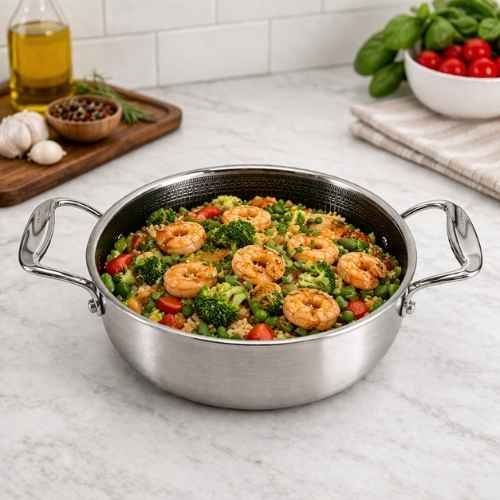
Premium Retail Tri-Ply Kadai with Toughened Glass Lid
Designed for premium retail markets and department stores. Includes a high-grade shatter-resistant tempered glass lid with steam vent rim, allowing visible cooking monitor without heat escape.
Available Sizes: 22cm to 28cm
Lid Type: 4mm Shatterproof Tempered Glass
Branding: Custom Laser Etched Base Logo
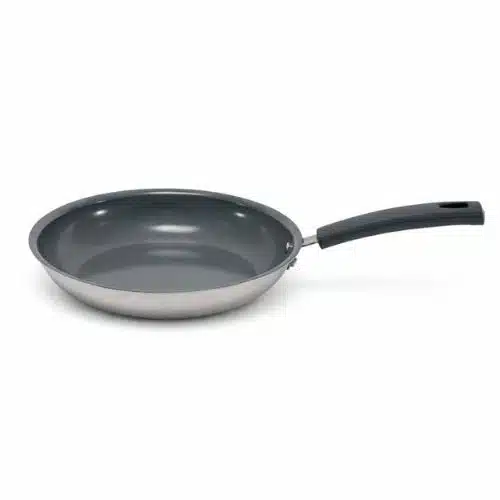
Tri-Ply Laser Honeycomb Hybrid Non-Stick Kadai
Combines the durability of stainless steel with the release properties of non-stick. Etched laser honeycomb stainless grid protects the PFOA-free coating from metal utensil damage.
Coating Tech: German Sol-Gel / PTFE Ceramic Hybrid
Utensil Rating: Metal Utensil Safe
Target Market: High-End Retail & E-Commerce Brands
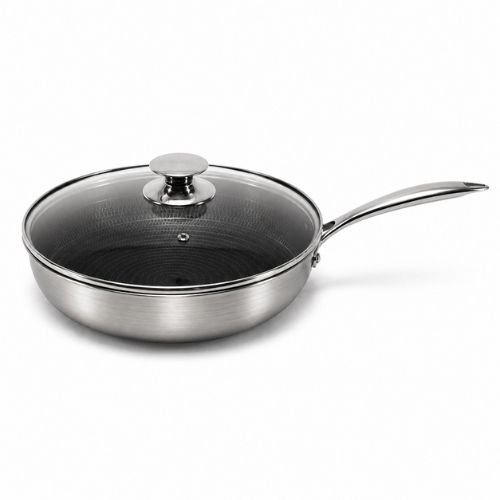
Tri-Ply Stainless Steel Deep Chef Pan / Flat-Bottom Kadai
Features an extended flat inductive base surface combined with steep curved deep wok sides. Ideal for Western chef stir-frying and multi-cuisine restaurant operational environments.
Handle: Long Ergonomic Cast SS Stick Handle + Helper Loop
Oven Rating: Oven Safe up to 260°C (500°F)
Certification: FDA, LFGB, EU Food Safe
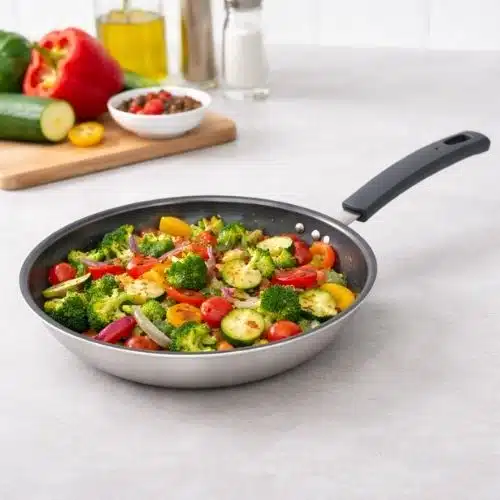
Heavy-Duty Commercial Tri-Ply Wok Kadai (3.0mm Gauge)
Engineered specifically for high-intensity commercial hotel kitchens and restaurant chains requiring extra structural mass against extreme thermal cycles and heavy spatula impacts.
Wall Thickness: 3.0mm Ultra-Heavy Clad
Rivet Assembly: 4-Rivet Heavy Duty Anchor
Capacity: 4.5 Liters to 8.5 Liters
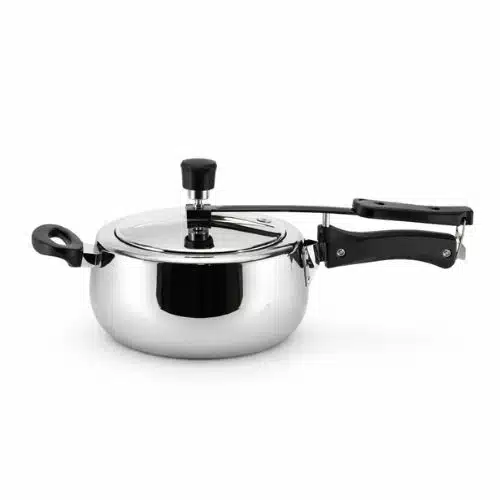
Tri-Ply Stainless Steel Pressure Cooker & Specialty Vessels
Complementary commercial tri-ply vessel range manufactured under identical metallurgical bonding processes, featuring inner-lid safety pressure lids and belly shape thermal contours.
Safety System: Triple Pressure Release Valves
Base Type: Full-Clad Induction Base
Compliance: CE, ISO 9001 Certified
4. Future Global Sourcing & Procurement Trends (2025–2030)
As corporate purchasing managers navigate supply chain disruptions, regulatory compliance, and shifting consumer behavior, key macro trends are shaping the future of global cookware sourcing. Integrating these insights into your purchasing matrix will protect your brand's market share over the next decade:
A. Total Elimination of PFAS, PFOA & Fluorinated Coatings
Regulatory authorities across the EU (REACH compliance reforms) and US state legislatures are enforcing strict bans on Forever Chemicals (PFAS/PTFE). Global buyers are rapidly substituting traditional non-stick pans with naturally non-reactive, uncoated Tri-Ply Stainless Steel Kadais or Sol-Gel ceramic hybrid finishes that guarantee 100% toxic-free cooking.
B. Universal Induction Standardization
As residential gas lines are phased out in new urban real estate across North America and Europe in favor of high-efficiency induction cooktops, cookware must feature flawless magnetic bottom response. Clad SS430 exterior layers ensure universal compatibility without requiring secondary stamped base plates that tend to detach over time.
C. Sourcing Diversification to Bangladesh (Tariff Optimization)
Global brand owners are seeking alternatives to traditional manufacturing hubs to mitigate geopolitical risk, anti-dumping duties, and rising labor costs. Bangladesh has emerged as the premier manufacturing alternative, providing zero-duty or low-tariff access to major European, North American, and Asian markets backed by low-cost energy and skilled labor.
D. Laser-Etched Micro-Pattern Surface Engineering
Future iterations of stainless cookware focus on physical surface modification rather than chemical coatings. Micro-etched laser grids create physical oil pockets, decreasing food contact surface friction while enabling consumers to use metal spatulas without destroying pan functionality.
5. Why Partner with Kiam Metal Industries Limited? Enterprise Strengths & E-E-A-T Authority
Selecting the right OEM/ODM manufacturer is the single most critical decision for kitchenware brand managers, supermarket procurement directors, and importers. Kiam Metal Industries Limited offers an unmatched combination of manufacturing scale, metallurgical precision, and export reliability.
34+ Years of Industrial Leadership (Established 1990)
Founded in 1990 and headquartered in the BSCIC Industrial Estate, Kushtia, Bangladesh, Kiam Metal Industries has grown from a regional pioneer into the No. 1 kitchenware brand and manufacturer in Bangladesh. Our decades of metallurgical refinement guarantee consistent quality across every batch of Tri-Ply Stainless Steel Kadai shipped overseas.
Unmatched Manufacturing Capacity & Infrastructure
- Human Capital: A highly trained industrial workforce exceeding 3,500 employees across specialized manufacturing divisions.
- Product Diversity: Over 500 active product lines spanning tri-ply cookware, die-cast aluminum casseroles, non-stick PTFE frypans, pressure cookers, and electric home appliances.
- Domestic & Global Footprint: Trusted by over 30,000+ retail outlets domestically and exporting to high-growth markets in Europe, the Middle East, Africa, and Asia.
State-of-the-Art Quality Assurance & Testing Protocol
Every Kiam Tri-Ply Stainless Steel Kadai undergoes rigorous laboratory testing before leaving our facility:
- Ultrasonic Cladding Flaw Detection: Inspects 100% of bonded sheet raw materials to guarantee zero micro-voids between SS304, Aluminum 1050, and SS430 layers.
- Thermal Shock Resistance Testing: Repeatedly heats vessels to 300°C followed by immediate cold water quenching to ensure zero delamination or base warping.
- Riveted Handle Shear Strength Test: Handles undergo hydraulic tension loads exceeding 150 kg to ensure zero mechanical failure under commercial kitchen stress.
- Salt Spray & Acid Resistance (ISO 9227): 72-hour continuous salt spray testing validates that SS304 interior layers resist pitting corrosion caused by acidic dishes.