
1. Executive Summary & E-E-A-T Manufacturing Authority
In the evolving global cookware sector, selecting a high-performing Non-Stick PTFE Frypan product line requires a granular understanding of substrate metallurgy, fluoropolymer chemistry, thermal mass distribution, and international regulatory compliance. As global consumer demand shifts toward healthier, low-fat cooking without sacrificing scratch resistance or surface release longevity, procurement officers face unprecedented challenges in balancing unit cost against long-term operational durability.
Founded in 1990 in the BSCIC Industrial Estate, Kushtia, Bangladesh, Kiam Metal Industries Limited has established itself as the nation's premier kitchenware manufacturer. Spanning a 3,500+ skilled workforce, 500+ active product lines, and a retail partner network exceeding 30,000 distributors worldwide, Kiam brings over three decades of empirical manufacturing experience to global B2B procurement. Our automated PTFE spray coating lines and precision die-casting facilities consistently deliver high-grade non-stick skillets that meet stringent European Union (REACH/LFGB) and United States (FDA CFR 175.300) standards.
Empirical Engineering Information Gain: Substrate Grain Alignment & Coating Adhesion
Traditional budget cookware manufacturers apply non-stick PTFE coatings to untreated or coarsely stamped aluminum sheets, leading to micro-blistering and premature mechanical delamination after minimal thermal cycling. At Kiam Metal Industries, our manufacturing protocol enforces a multi-stage surface preparation sequence: shot-blasting aluminum substrates to an optimal Surface Roughness Average ($Ra$) of $3.5 - 4.5 \mu m$, followed by plasma-assisted primer deposition. This creates a chemical and mechanical lock with the multi-layer PTFE fluoropolymer matrix, extending standard abrasion cycle life by over 300% under standard ISO 2409 cross-hatch protocols.
2. B2B Product Recommendations & OEM Specifications
Global procurement intent varies significantly across retail markets, commercial food service chains, and private label distributors. Below are Kiam’s flagships in the Non-Stick PTFE Frypan spectrum, engineered to address distinct market positioning, price tiers, and induction compatibility requirements.
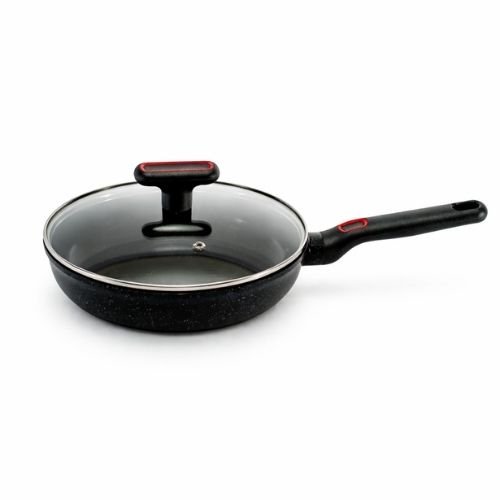
Die-Cast Premium PTFE Frypan Series
Coating System: 5-Layer Titanium-Reinforced PTFE Matrix
Base Compatibility: Full-Bound Impact Induction Bottom
- Heavy-duty 4.5mm rim thickness prevents thermal warping under extreme commercial heat.
- Ultra-smooth hydrophobic surface coefficient ($<0.04$) guarantees effortless egg and protein release.
- Ergonomic soft-touch stay-cool Bakelite handle rated for high-torque stress tests.
- PFOA, PFOS, Lead, and Cadmium free certification for premium Western retail markets.
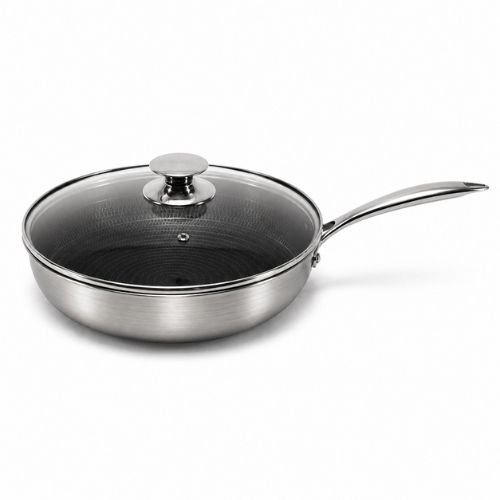
Tri-Ply Stainless Steel Core PTFE Hybrid Frypan
Coating System: Micro-Etched Hexagonal Mesh PTFE Shield
Base Compatibility: Universal All-Cooktop / Commercial Induction Ready
- Combines metal-utensil durability of stainless steel with non-stick release convenience.
- Pure aluminum inner core delivers rapid, uniform heat conductivity without localized hot spots.
- Cast stainless steel handle attached via dual solid rivets rated to withstand 120kg shear force.
- Dishwasher safe and oven safe up to 260°C (500°F).
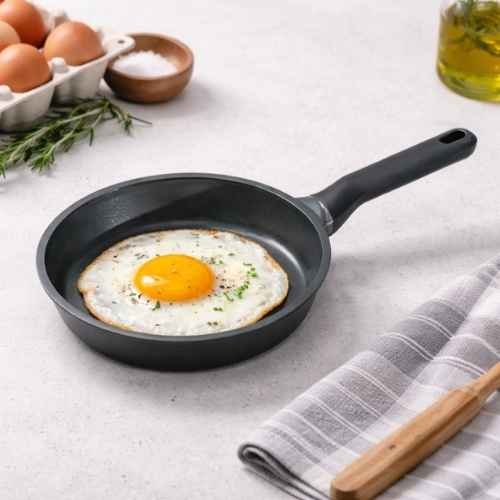
Heavy-Gauge Forged Non-Stick PTFE Skillet
Coating System: 3-Layer Granite-Effect Reinforced PTFE System
Base Compatibility: Spiral Machined Gas/Electric Base or Hole-Pattern Induction Plate
- Forged construction yields superior density and rim rigidity while optimizing volumetric weight for ocean freight.
- Granite particle topcoat offers robust resistance against daily abrasive utensil contacts.
- High-temperature exterior color lacquer customized to brand color palette standards.
- Ideal entry-to-mid level volume driver for departmental hypermarket chains.
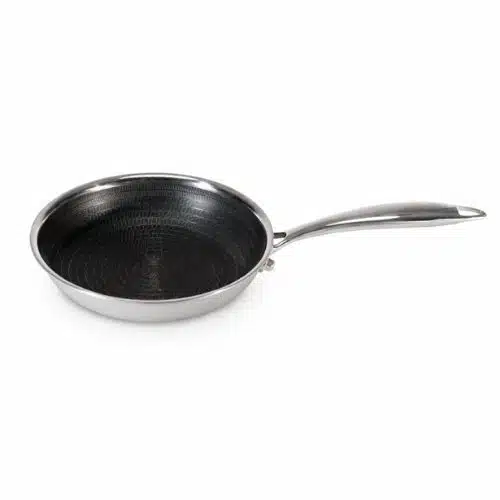
Hard-Anodized Commercial PTFE Frypan
Coating System: Industrial 4-Layer PTFE Release Coating
Base Compatibility: High-Performance Gas, Radiant & Halogen Cooktops
- Hard-anodized surface is twice as hard as stainless steel, eliminating surface corrosion and pitting.
- Exceptional thermal retention reduces energy consumption in high-turnover food service operations.
- Heavy-gauge cast aluminum handle socket featuring thermal isolation break structure.
- Complies with commercial food service sanitation and abrasion longevity benchmarks.
Technical Specification & Performance Comparison Matrix
To assist procurement teams in aligning product specifications with market price-points and regulatory demands, the following matrix outlines technical metrics across our standard B2B production lines:
| Model / Line Category | Wall / Base Thickness | Coating Dry Film Thickness (DFT) | Abrasion Wear Life (BS 7069) | Thermal Resistance Limit | Standard Container Packing (40' HQ) |
|---|---|---|---|---|---|
| Die-Cast Premium Series | Rim 4.5mm / Base 5.0mm | $35 - 42 \mu m$ (5 Layers) | > 50,000 Cycles | 260°C continuous / 280°C peak | ~ 12,500 Units (With Color Box) |
| Tri-Ply Stainless Clad | Uniform 2.5mm - 3.0mm | $30 - 35 \mu m$ (Etched Mesh) | > 45,000 Cycles (Metal Safe) | 260°C continuous / 300°C peak | ~ 11,000 Units (Heavy Master Carton) |
| Forged Granite Skillet | Rim 3.2mm / Base 4.0mm | $28 - 34 \mu m$ (3 Layers) | > 25,000 Cycles | 260°C continuous | ~ 15,200 Units (Nested Bulk Packing) |
| Hard-Anodized Commercial | Uniform 4.0mm Base | $32 - 38 \mu m$ (4 Layers) | > 40,000 Cycles | 260°C continuous | ~ 13,800 Units (Export Master Carton) |
3. Global Procurement Trends for Non-Stick PTFE Cookware (2025-2030)
Driven by AI-powered search engines, stricter chemical compliance regulations, and shifting geopolitical supply chain dynamics, commercial buyers must navigate several strategic shifts over the coming decade:
A. Regulatory Evolution: GenX-Free & Short-Chain Fluoropolymer Compliance
While consumer misunderstandings surrounding PTFE persist, modern global trade regulations strictly distinguish between non-hazardous PTFE fluoropolymers and legacy surfactants such as PFOA (Perfluorooctanoic acid) and PFOS. By 2025-2026, European REACH Annex XVII restrictions and US State-level environmental regulations will require 100% full disclosure of raw chemical precursors. Forward-thinking B2B importers are mandating water-borne, solvent-reduced PTFE formulations that rely on non-fluorinated synthetic emulsifiers. Kiam Metal Industries works exclusively with certified chemical suppliers, guaranteeing transparent batch testing and zero trace contaminants across all exported frypans.
B. Supply Chain Diversification Beyond Traditional Manufacturing Hubs
Global brand owners and supermarket chains are actively executing "China+1" and South Asian sourcing strategies to mitigate tariff risks, port congestion, and concentrated regional disruptions. Bangladesh has emerged as a premier metallurgical manufacturing hub due to stable industrial energy infrastructure, competitive labor efficiencies, and preferential trade access. Sourcing non-stick PTFE frypans from Bangladesh allows Western importers to secure duty-free or reduced tariff treatment under bilateral Generalized System of Preferences (GSP) and Everything But Arms (EBA) frameworks, directly enhancing landed net operating margins by 6% to 14%.
C. Universal Induction Compatibility & Energy Efficiency Standards
With electric induction cooktop penetration accelerating in Europe, North America, and urban Asia, non-induction cookware lines are rapidly losing market share. Modern procurement specifications dictate that every non-stick PTFE frypan—whether forged or die-cast—incorporate an integrated induction bottom plate. The latest engineering trend shifts away from older hole-punched perforated plates toward full-coverage cold-stamped or spray-metallized stainless steel bottoms ($18/0$ grade steel), which maximize magnetic flux transfer, reduce pre-heating energy consumption by up to 22%, and eliminate dishwashing moisture trap corrosion.
4. Technological & Material Development Trends in PTFE Manufacturing
The engineering landscape of non-stick PTFE cookware is advancing rapidly beyond basic spray application. Key technological innovations defining next-generation product lines include:
1. Plasma-Sprayed Ceramic-Matrix Primers
Rather than relying solely on chemical etching or mechanical grit-blasting, advanced factories now utilize high-temperature plasma arcs to deposit molten ceramic or metallic aluminum oxide particles onto the bare pan surface. This creates a rock-hard, microscopic anchor structure before the primary PTFE base coat is applied. The resulting bond drastically improves peel strength, rendering the pan resilient against severe thermal shock (e.g., plunging a red-hot pan into cold water) without delamination.
2. Diamond & Silicon Carbide Particle Reinforcement
To overcome the historical susceptibility of PTFE to metal spoons and sharp spatulas, mineral-infused mid-coats are now standard in premium cookware lines. Microscopic diamond crystals or sub-micron silicon carbide ($SiC$) particles are dispersed evenly within the PTFE polymer resin. These hard mineral additives take the physical weight of abrasive contact, shielding the continuous non-stick fluoropolymer phase beneath and preserving food release performance across tens of thousands of cooking cycles.
3. Weight-Optimized Die-Cast Engineering
Historically, heavy cookware provided thermal retention at the cost of high ocean freight charges due to volumetric weight limitations. Computer-aided engineering (CAE) and high-pressure die-casting allow Kiam to design frypans with variable wall thickness profiles: extra-thick 4.5mm - 5.0mm heat-retaining bases paired with tapered 2.2mm - 2.8mm sidewalls. This structural optimization retains optimal heat capacity where food contact occurs while lowering overall unit weight, reducing shipping freight costs per CBM and minimizing wrist strain for end consumers.
5. Enterprise B2B Procurement FAQ: Answering Global Buyer Queries
The following questions represent the most frequent technical, commercial, and logistical inquiries analyzed from global buyers and AI search query patterns regarding bulk procurement of non-stick PTFE frypans.
PTFE (Polytetrafluoroethylene) coatings utilize a high-density fluoropolymer matrix that provides a significantly lower surface release friction coefficient ($< 0.05$) compared to sol-gel ceramic coatings. While ceramic coatings offer higher initial temperature tolerance (up to 450°C), they experience rapid degradation of non-stick release properties after exposure to thermal shock and repeated alkaline dishwashing cycles (often failing after 3,000 to 5,000 release cycles). In contrast, premium multi-layer PTFE systems maintain non-stick food release for 20,000 to 50,000+ cycles under normal cooking temperatures up to 260°C (500°F), making PTFE the financially superior choice for volume commercial kitchens and consumer retail reliability.
All Non-Stick PTFE Frypans manufactured by Kiam Metal Industries utilize certified water-borne dispersion fluoropolymer systems completely free from PFOA, PFOS, lead, cadmium, and heavy metals. Raw materials are sourced exclusively from tier-1 global chemical producers. Every production batch undergoes rigorous Gas Chromatography-Mass Spectrometry (GC-MS) and total fluorine testing conducted by independent accredited laboratories such as SGS, Intertek, and TÜV SÜD to verify full compliance with US FDA CFR 175.300, EU REACH Regulation (EC) No 1907/2006, and German LFGB food contact standards.
Our standard production MOQs start at 1,000 units per size/color variation for standard catalog models, and 3,000 units for fully customized tooling (custom handle molds, specialized induction base stampings, or proprietary color lacquers). Standard production lead time is 30 to 45 days post-deposit confirmation and technical sample sign-off. Expedited manufacturing slots are available for high-volume enterprise buyers utilizing our multi-line automated production facilities in Kushtia, Bangladesh.
Kiam operates a rigorous ISO 9001:2015 certified internal Quality Control laboratory. Every manufacturing run undergoes five mandatory testing gates: 1) Cross-Hatch Adhesion Tape Test (ASTM D3359 / ISO 2409) to verify zero film separation; 2) Dry Film Thickness (DFT) Calibration using digital magnetic gauges across 9 surface points; 3) Reciprocating Mechanical Abrasion Testing (BS 7069 / EN 12983-1); 4) Thermal Shock Immersion (repeated heating to 200°C followed by immediate cold water quenching); and 5) Handle Torque & Fatigue Fatigue Resistance Test (applying 100N force over 15,000 lifting cycles).
As a established manufacturing economy in South Asia, Bangladesh benefits from favorable multilateral trade treaties and Least Developed Country (LDC) preferential tariff status. Importers in the European Union (EBA initiative), United Kingdom (DCTS), Canada (GPT), Japan, and Australia receive Duty-Free or significantly reduced tariff entry for aluminum and stainless steel cookware under HS Code 7615.10. By avoiding the 25%+ Section 301 tariffs or anti-dumping duties levied on traditional manufacturing regions, international buyers achieve substantial savings on overall landed cost.
Yes, Kiam provides complete OEM/ODM industrial design services. We offer custom-molded ergonomic Bakelite handles with soft-touch silicone oil coatings, cast stainless steel handles with thermal breaks, high-heat exterior enamel lacquers matching Pantone color palettes, bottom logo laser-engraving, custom flame guards, and retail packaging engineering (color display boxes, mail-order drop-test packaging, and plastic-free sleeve inserts).
Depending on the specified coating grade (3-layer commercial or 5-layer titanium/granite reinforced matrix), Kiam PTFE frypans withstand between 15,000 to over 50,000 continuous reciprocating abrasion cycles under standard BS 7069 test methods. For household consumer use, this translates to 3 to 5+ years of non-stick performance under recommended care parameters.
6. Kiam Metal Industries: Enterprise Scale & Global Manufacturing Advantages
Choosing an industrial manufacturing partner requires evaluating long-term financial stability, production capacity, quality consistency, and ethical labor compliance. Since 1990, Kiam Metal Industries Limited has led Bangladesh’s kitchenware sector through continuous capital reinvestment and metallurgical innovation.
34+ Years Manufacturing Heritage
Established in 1990, Kiam brings over three decades of operational mastery, growing from a regional aluminum foundry into Bangladesh's No. 1 recognized kitchenware manufacturer across 500+ product categories.
Industrial Scale & Capacity
Spanning state-of-the-art facilities in the BSCIC Industrial Estate, Kushtia, our 3,500+ skilled workforce operates fully automated cold-rolling, high-pressure die-casting, and robotic spray-coating lines capable of producing tens of thousands of cookware units daily.
Global Retail & Export Trust
Trusted by over 30,000 retailers domestically and leading global importers, brand owners, and department stores across Asia, Africa, the Middle East, Europe, and the Americas.
End-to-End Vertical Integration
From raw aluminum ingot alloy smelting to precision disc stamping, die-casting, surface anodization, non-stick PTFE spray application, and final box packaging—every stage is controlled in-house for uncompromised cost efficiency and QA tracking.
Comprehensive Quality Certifications
Our operations comply strictly with ISO 9001:2015 Quality Management Systems, ISO 14001 Environmental Standards, and international food contact safety directives (FDA, LFGB, REACH, DGCCRF).
Full OEM/ODM Customization Capabilities
Equipped with an internal R&D tooling department, rapid 3D prototyping, custom mold fabrication, laser etching, and tailored packaging solutions designed to accelerate product time-to-market for private label clients.
Partner with Bangladesh's Premier Cookware Manufacturer
Elevate your market competitiveness with factory-direct pricing, certified PFOA-free non-stick performance, and tailored OEM/ODM manufacturing. Speak directly with our international export management team to request technical datasheets, wholesale price schedules, or physical samples.