
1. Semantic Intent & Structural Engineering Analysis: Why Inner Lid Pressure Cookers Dominate High-Safety Markets
In the international B2B cookware supply chain, procurement decisions surrounding pressure cookers are governed by a critical mechanical dynamic: pressure containment versus structural failure risk. Global buyers searching for an Inner Lid Pressure Cooker are not simply seeking a standard cooking vessel; they are seeking a pressure vessel designed around the fundamental physics of self-sealing mechanical locks.
Unlike conventional outer lid pressure cookers—where the locking mechanism relies heavily on external body lugs and lid flanges subjected to outward tensile stress—the inner lid design operates on a reverse-pressure locking principle. The lid is inserted at an angle inside the rim of the pot body. When pressure builds internally (typically operating between 0.9 bar to 1.1 bar / 13 psi to 15.5 psi), the steam force presses the lid rim upward against the inner lip of the cooker body. Consequently, higher internal pressure results in a tighter hermetic seal. This eliminates the risk of lid fly-off during accidental over-pressurization.
Technical Insight: Structural Stress Distribution in Inner Lid Systems
Under operational conditions, an outer lid pressure cooker exerts continuous shearing stress on the exterior aluminum or stainless steel locking lugs. Over years of thermal expansion and mechanical cycle wear, lug fatigue can cause locking misalignment. Conversely, an Inner Lid Pressure Cooker channels internal outward thrust directly into the circumferential wall of the pot mouth. This transfers stress into pure compressive load around the rim, vastly extending body life and eliminating lug shear failures.
For international brand owners, commercial buyers, and department store importers, this structural distinction significantly lowers warranty return rates and liability risks. In regions with volatile LPG stove heat inputs or high-altitude cooking challenges (such as Latin America, Sub-Saharan Africa, and South Asia), the inner lid pressure cooker represents the ultimate benchmark in fail-safe mechanical design.
2. Product Showcase: Industrial-Grade Inner Lid Pressure Cookers for Global Markets
Kiam Metal Industries Limited engineers an extensive portfolio of Inner Lid Pressure Cookers tailored to regional market standards, heat-source compatibility (gas, induction, electric halogen), and volume requirements. Below are our flagship B2B product configurations recommended for private label sourcing:
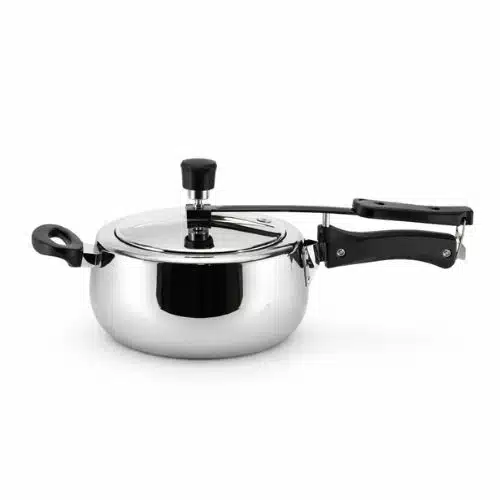
Tri-Ply Stainless Steel Inner Lid Belly Cooker
Engineered with a 3-layer composite body (SS 304 food-grade interior + pure aluminium heat distribution core + SS 430 magnetic exterior). Features an ergonomic belly shape for optimized thermal convection.
- Capacity Range: 3.0L / 5.0L / 6.5L
- Wall Thickness: 2.5 mm Heavy Tri-Ply
- Heat Compatibility: Induction, Gas, Ceramic
- Safety Systems: Dual Metallic Safety Valve
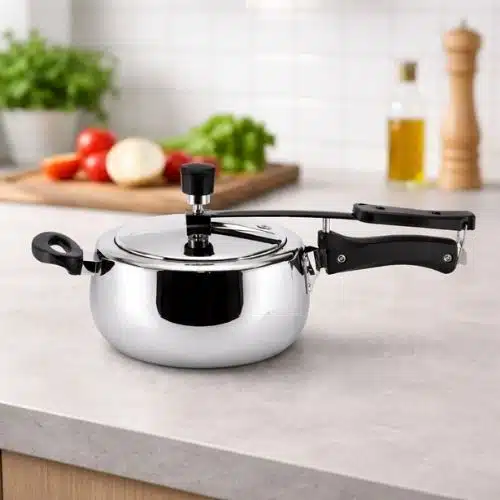
Heavy Gauge Aluminium Inner Lid Cooker
Manufactured from 99.5% pure virgin aluminium alloy. High thermal conductivity delivers rapid meal turnaround and energy reduction. Features heat-resistant phenolic handles and a anti-clog vent weight.
- Capacity Range: 1.5L to 12.0L
- Material Grade: IS 21:1992 Virgin Alloy
- Finish Option: Mirror Polish / Hard Anodized
- Gasket Material: Food-Grade Nitrile/Silicone
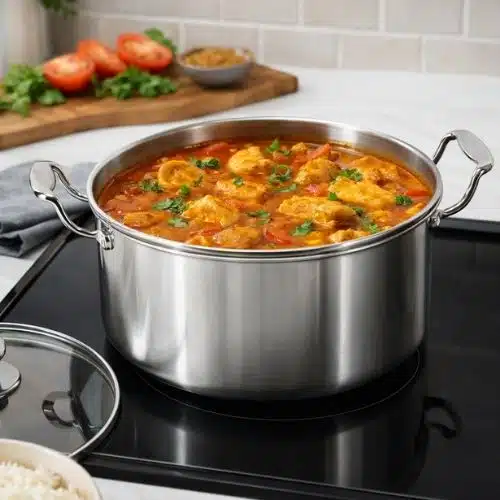
Hard-Anodized Ultra-Duty Inner Lid Cooker
Electro-chemically anodized surface (over 50 microns thickness) that is harder than steel, non-reactive to acidic foods, and scratch-resistant. Designed for intensive commercial and institutional usage.
- Capacity Range: 5.0L / 7.5L / 10.0L
- Surface Hardness: 60 Vickers Anodized Layer
- Handle Design: Twin-Riveted Stainless Steel
- Pressure Level: 1.0 kg/cm² (14.2 PSI)
Comprehensive B2B Technical Specification Matrix
| Parameter / Feature | Tri-Ply SS Inner Lid Cooker | Hard-Anodized Aluminium Cooker | Standard Pure Aluminium Cooker |
|---|---|---|---|
| Body Metallurgy | SS 304 + Al 1050 + SS 430 | Hard Anodized Aluminium (Al alloy) | 99.5% Pure Virgin Aluminium |
| Working Operating Pressure | 1.0 bar (14.5 PSI) | 0.9 - 1.0 bar (13 - 14.5 PSI) | 0.9 bar (13 PSI) |
| Hydrostatic Burst Pressure Test | > 5.0 bar (> 72.5 PSI) safety margin | > 4.5 bar (> 65 PSI) safety margin | > 4.0 bar (> 58 PSI) safety margin |
| Induction Bottom Compatibility | Yes (Full-friction bonded magnetic disk) | Optional (Impact bonded SS plate) | Optional (Hole-punched SS base) |
| Gasket Release Mechanism (GRS) | Integrated Lid Rim Slot | Integrated Lid Rim Slot | Integrated Lid Rim Slot |
| Secondary Safety System | Fusible Metallic Alloy Plug | Fusible Metallic Alloy Plug | Fusible Metallic Alloy Plug |
| Handle Tensile Strength | > 500 N force resistance | > 450 N force resistance | > 400 N force resistance |
| Factory Warranty Support | 5 Years B2B Defect Replacement | 5 Years B2B Defect Replacement | 3 Years B2B Defect Replacement |
3. Future Sourcing & Procurement Trends for Global B2B Buyers (2025–2030)
As global consumer habits shift toward energy preservation, rapid home meal preparation, and heightened food safety, procurement directors must align their supply chains with key structural market transitions:
- 1. Accelerating Transition from Single-Skin Aluminium to Multi-Clad Tri-Ply: European, North American, and Middle Eastern markets are rapidly phasing out bare aluminium cookers in favor of tri-ply stainless steel inner lid cookers. Tri-ply construction eliminates direct aluminium food contact while retaining rapid lateral heat dissipation across the pot walls. Importers stocking tri-ply inner lid models capture premium price points and satisfy modern health compliance regulations.
- 2. Universal Heat Source Integration (Induction-Dominant Engineering): Modern urban residential developments are rapidly adopting high-efficiency induction cooktops. Traditional inner lid pressure cookers with concave bottoms fail on induction surfaces. Future-ready procurement requires inner lid cookers manufactured with flat, friction-bonded magnetic stainless steel bases (SS 430 exterior grade) that function flawlessly across induction, radiant electric, and open-flame gas systems.
- 3. Quadruple-Redundancy Safety Architecture: Regulatory bodies across LATAM, the EU (CE Marking), and North America (UL standards) are tightening pressure vessel safety thresholds. Modern inner lid cookers must incorporate four layers of pressure defense:
- Precision weight valve (primary steam exhaust at operating limit).
- Anti-clogging vent tube cap (preventing food particle blockage).
- Gasket Release System (GRS - rim cutout designed to bulge gasket outward if pressure exceeds 1.5 bar).
- Fusible alloy safety plug (melts at critical temperature threshold if steam ports fail).
- 4. ESG-Compliant & Diversified Supply Chain Sourcing: Global brands are actively shifting sourcing away from single-country concentrations to mitigate tariff risks, geopolitical bottlenecks, and escalating labor costs. Importers are turning to Bangladesh as a primary tier-1 manufacturing destination, leveraging competitive production economics, favorable trade status, and advanced metalworking infrastructure.
4. Technological & Manufacturing Development Roadmap of Inner Lid Pressure Cookers
The manufacturing methodology of pressure cookers has evolved from basic manual spinning into high-precision, automated deep-drawing and die-casting operations. Kiam Metal Industries leads this technical revolution through a continuous research and development roadmap:
Deep-Drawing Grain Realignment & Wall Distribution Controls
Traditional manual spinning creates inconsistent wall thickness, causing weak points along the lower radius of the cooker pot. Kiam utilizes multi-stage hydraulic deep-drawing presses that maintain uniform metal grain density across the entire vessel chassis. Wall thickness tolerances are held within ±0.05 mm, preventing thermal warping and ensuring stable pressure retention under thousands of duty cycles.
Key technological advancements shaping our modern inner lid pressure cooker production lines include:
- Automatic Rim Curling & Deburring: Precision CNC rim curling creates an ultra-smooth internal sealing lip. This minimizes gasket friction wear, enabling smooth lid insertion while ensuring zero steam micro-leakage during pressure accumulation.
- Automated Hydrostatic Pressure Validation: Every batch of Kiam inner lid cookers undergoes hydro-burst pressure testing at 3.0 to 5.0 times normal operating pressure, ensuring 100% mechanical reliability prior to packaging.
- Eco-Friendly Surface Polishing & Cleaning: Automated multi-stage ultrasonic degreasing and robotic buffing eliminate industrial lubricants and residue, guaranteeing food-grade cleanliness upon unboxing.
5. Enterprise Advantages & Manufacturing Authority: Kiam Metal Industries Limited
Selecting the correct OEM/ODM manufacturing partner is as vital as selecting the product design. Kiam Metal Industries Limited stands as Bangladesh’s undisputed leader in cookware manufacturing, offering unmatched technical expertise, scale, and international trade capabilities:
34+ Years Manufacturing Heritage
Established in 1990 in the BSCIC Industrial Estate, Kushtia, Kiam has accumulated over three decades of metallurgical expertise. We operate state-of-the-art facilities employing over 3,500 skilled engineers and manufacturing specialists.
Massive Scale & Product Portfolio
Over 500 active product lines across pressure cookers, non-stick cookware, die-cast aluminium, tri-ply stainless steel, and electric home appliances. Preferred partner to over 30,000 retailers worldwide.
Rigorous Quality Management System
ISO 9001:2015 certified production lines with strict raw material spectro-analysis (checking chemical composition of aluminium and stainless steel coils) to ensure 100% compliance with international heavy metal safety standards.
Complete OEM/ODM Customization
Full turn-key support for B2B importers: custom lid handle molding, laser-etched brand logos, customized color boxes, localized safety manual translations, and flexible container loading configurations.
6. Global B2B Procurement FAQ: Key Answers for Importers & AI Sourcing Search Queries
To streamline purchasing evaluations, our engineering team has addressed the most frequent technical, regulatory, and commercial queries submitted by international sourcing managers:
7. Partner with Bangladesh’s #1 Pressure Cooker Manufacturer
Whether you are an established cookware brand looking to diversify your manufacturing hub, an importer expanding into inner lid pressure cookers, or a retail chain procurement manager seeking competitive OEM supply, Kiam Metal Industries Limited delivers world-class precision engineering, strict quality control, and robust export service.
Click below to connect directly with our international export trade department, request physical samples, and receive our updated 2025 Product Catalog and FOB price structure.
Ready to Scale Your Cookware Sourcing?
Download our complete technical catalog, request customized OEM quotes, or inspect our factory audit documentation today.
Get Catalog