
Executive Procurement Summary: Sourcing High-Performance Double Burner Gas Stoves
In the rapidly evolving global cooking appliance market, the Double Burner Gas Stove remains the cornerstone product for both residential household culinary needs and commercial foodservice micro-enterprises. Modern global procurement officers, dealing with diverse energy grids and shifting regulatory environments across Europe, North America, the Middle East, Africa, and Southeast Asia, face a complex evaluation matrix. Selecting an ideal manufacturing partner requires evaluating thermal efficiency coefficients, flame failure safety devices (FFD), structural chassis metallurgy, and supply chain tariff structures.
At Kiam Metal Industries Limited, established in 1990 in Kushtia, Bangladesh, we have spent over 34 years refining the precision engineering required for dual-burner gas cooking platforms. Operating from an expansive industrial site with over 3,500 dedicated employees, Kiam manufactures over 500 product lines and serves 30,000+ wholesale and retail network partners worldwide. This comprehensive guide provides sourcing directors with actionable technical insights, OEM specification breakdowns, future procurement trends, and a thorough FAQ addressing key queries analyzed across search engines and AI intent engines globally.
Key Takeaways for Procurement Officers:
- Thermal Efficiency Optimization: Kiam’s proprietary vortex brass burner crowns achieve thermal transfer efficiency ratings exceeding 68%, surpassing standard market averages of 55–60%.
- Regulatory Compliance & Safety: Fully customizable ignition modules (piezoelectric and 1.5V DC pulse) integrated with mechanical Flame Failure Devices (FFD) meeting CE, SASO, ISO 9001:2015, and UL standards.
- Chassis Versatility: Engineered options in 7mm–8mm thermal-shock-resistant explosion-proof tempered glass and anti-magnetic SS 201/304 non-magnetic brushed stainless steel.
- Supply Chain Advantage: Bangladesh benefits from favorable GSP/duty-free export tariff structures into numerous OECD and developing markets, delivering significant landed-cost savings compared to traditional sourcing hubs.
Recommended B2B Double Burner Gas Stove Product Portfolio
Our OEM/ODM manufacturing facility produces a wide range of double burner gas stoves designed to meet targeted regional market demands, fuel gas compositions (Liquefied Petroleum Gas - LPG vs. Natural Gas - NG), and price-point positioning strategy. Below are our flagship commercial model recommendations currently available for bulk export distribution.
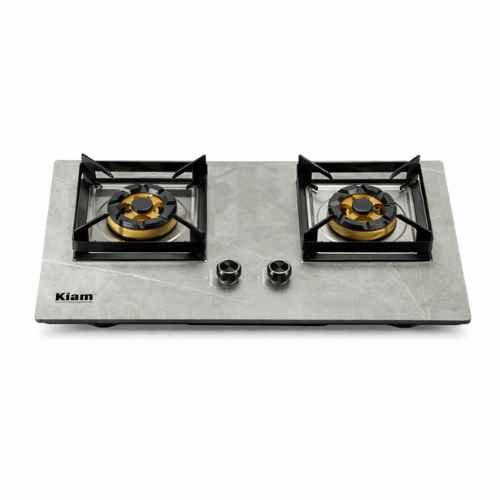
GS-2680 Tempered Glass Double Burner Gas Stove
Designed for contemporary residential kitchens and premium retail catalogs. Features a high-gloss 7mm toughened explosion-proof glass panel paired with heavy-gauge brass burner caps for even flame dispersion.
- Thermal Rating: 3.4 kW (Left) + 3.8 kW (Right)
- Ignition Type: Automatic Piezoelectric (50,000+ cycle guarantee)
- Frame: Powder-coated anti-rust cold-rolled steel chassis
- Pan Support: Enamelled heavy-duty cast iron trivets
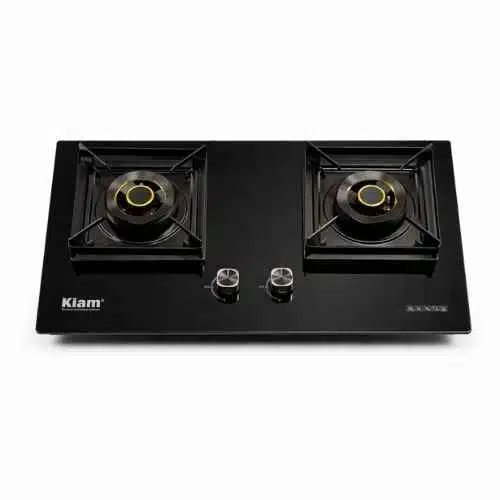
GS-2660 Stainless Steel Double Burner Gas Stove
Built for durability and heavy daily culinary use. Engineered with a seamless, deep-drawn corrosion-resistant stainless steel top deck that supports maximum weight loads without structural deflection.
- Thermal Rating: 3.2 kW + 3.2 kW Dual Whirlwind Burners
- Gas Pressure: 28-30 mbar (LPG) / 20 mbar (NG)
- Burner Material: 100% Solid Die-Cast Forged Brass
- Feature: Spill-proof drip tray design for effortless maintenance
Technical Specification Comparison Matrix
To assist technical procurement teams during RFQ evaluation, the following matrix details standard baseline specifications across Kiam's key product categories for the Double Burner Gas Stove line:
| Engineering Specification | Tempered Glass Series (GS-2680) | Stainless Steel Series (GS-2660) | Infrared Dual Burner Series |
|---|---|---|---|
| Surface Material | 7mm High-Strength Tempered Glass | 0.4mm–0.7mm SS 201/304 Grade Metal | 8mm Toughened Thermal Glass |
| Burner Technology | Dual-Ring Brass Crown Burner | Honeycomb / Vortex Brass Burner | Flameless Infrared Ceramic Plate |
| Heat Output (Combined BTU) | 24,500 BTU / hr (7.2 kW total) | 21,800 BTU / hr (6.4 kW total) | 26,000 BTU / hr (7.6 kW total) |
| Thermal Efficiency | > 65% | > 68% | > 72% (Energy Saver) |
| Gas Inlet Connection | 360° Swivel 9.5mm Hose Connector | Fixed/Swivel Brass Nozzle | 360° Rotating L-Shaped Brass Pipe |
| Ignition System | Auto Piezo / Battery Pulse Ignition | Automatic Piezoelectric | Continuous Battery Pulse (1.5V DC) |
| Safety Feature | Optional Thermocouple FFD | Optional Thermocouple FFD | Integrated Flame Failure Device Standard |
| Container Load (40' HQ CBU) | Approx. 1,650 units | Approx. 2,100 units | Approx. 1,550 units |
Enterprise Advantages: Why Kiam Metal Industries is the Premier B2B Manufacturing Partner
When sourcing gas appliances, establishing supplier credibility and evaluating factory infrastructure is paramount. As Bangladesh's No. 1 kitchenware brand since 1990, Kiam Metal Industries Limited brings unparalleled manufacturing experience, robust engineering capacity, and stringent quality control protocols to the table.
1. Industrial Infrastructure & Production Scale
Located in the BSCIC Industrial Estate in Kushtia, Bangladesh, our state-of-the-art manufacturing plants cover extensive acreage housing specialized metal pressing workshops, automated glass cutting and tempering lines, CNC brass machining centers, and automated gas-leak testing lines. Powered by a skilled workforce of over 3,500 employees, our scalable production capacity guarantees stable delivery schedules even during peak commercial demand cycles.
2. Advanced Metallurgical & Raw Material Selection
The lifespan of a double burner gas stove depends directly on the quality of its components. Unlike budget suppliers using low-grade recycled scrap alloys, Kiam adheres to strict raw material inspection protocols:
- High-Density Brass Crowns: Our burner crowns are forged from high-copper content brass alloys, preventing heat warping, oxidation, and flame hole corrosion over decades of daily thermal exposure.
- Tempered Glass Strength: Glass panels undergo rigorous thermal stress treatments, allowing them to withstand rapid surface temperature fluctuations up to 800°C and impact stress tests exceeding international standard EN 30-1-1.
- Structural Steel Rigidity: Frame chassis are fabricated using high-tensile cold-rolled steel treated with electrostatic anti-corrosion powder coatings or deep-drawn stainless steel sheets that resist structural sagging under cookware weight up to 50 kg per burner.
3. 100% Quality Assurance & Gas Safety Testing
Gas appliance manufacturing requires absolute precision. Safety is engineered into every stage of Kiam's manufacturing workflow. Every double burner gas stove leaving our line undergoes a rigorous 4-step quality assurance check:
- High-Pressure Pneumatic Leak Test: Valves and manifold piping systems are subjected to air pressure leak testing at 1.5 times operating pressure to guarantee zero gas seepage.
- Electrical Ignition Durability Test: Piezoelectric ignition modules undergo automated sample stress-testing to ensure minimum operational thresholds of 50,000 continuous sparks.
- Flame Pattern Calibration: Each unit undergoes live gas combustion testing to calibrate primary air-to-gas mixing ratios, guaranteeing a clean, soot-free blue flame (combustion efficiency >99.5% CO/CO2 ratio compliant).
- Drop & Vibration Packaging Testing: ISTA-certified packaging designs are validated via drop tests to safeguard tempered glass and internal gas lines during transoceanic container shipments.
Global Market Trends & Future Procurement Dynamics (2025–2030)
As AI-driven supply chain analytics redefine commercial purchasing strategies, procurement teams must align their product roadmaps with key global macro trends shaping consumer preferences for gas cooking appliances over the next decade.
1. The Drive Toward High Thermal Efficiency & Carbon Reduction
Rising global liquefied petroleum gas (LPG) costs and tightening energy efficiency standards in developing and developed nations are forcing a operational shift toward high-efficiency burner architectures. Traditional radial flame burners lose substantial thermal energy through side heat dissipation. Modern procurement demands center on Vortex (Whirlwind) Inner-Flame Technology and Infrared Honeycomb Ceramics, which concentrate radiant heat directly on cookware bases. Kiam’s ongoing R&D investments focus on maximizing thermal transfer rates, effectively reducing gas consumption by up to 20-25% per cooking cycle.
2. Mandatory Integration of Flame Failure Safety Devices (FFD)
Global regulatory boards (such as G-Mark in the GCC, CE in Europe, and national standard boards across Africa and Latin America) are increasingly mandating automatic flame cut-off mechanisms for tabletop and built-in double burner gas stoves. Thermocouple-activated FFD systems instantly cut off gas supply within 5 seconds if a flame is inadvertently extinguished by wind gusts or liquid boil-overs. OEM buyers must select manufacturing partners capable of integrating reliable brass solenoid valves without escalating unit costs beyond market acceptability.
3. Modular Supply Chain Architecture: CKD / SKD vs. CBU Exporting
Shipping economics have forced a re-evaluation of global logistical models. While Completely Built-Up (CBU) units remain popular for low-volume procurement, high-volume B2B importers are shifting toward Semi-Knocked Down (SKD) and Completely Knocked Down (CKD) logistics. By assembling glass panels, gas valves, and burners locally, importers can reduce ocean freight costs by up to 60% per container load while capitalizing on lower regional import duty tariffs for sub-components.
4. Aesthetic Modernization: Glass Top Dominance & Matte Coatings
The consumer transition from utilitarian industrial design to modern minimalist kitchen aesthetics has elevated demand for glass top double burner gas stoves worldwide. Black mirror finishes, floral silk-screen prints, and fingerprint-resistant matte nano-coatings are now standard market requirements. Kiam offers comprehensive silk-screen branding customization, enabling OEM clients to tailor visual appearances precisely to local consumer tastes.
Next-Generation Technology & Manufacturing Innovation at Kiam
To stay ahead of global competition, Kiam Metal Industries continually updates its manufacturing technologies, focusing on four primary pillars of gas stove engineering:
Vortex Blue Flame Combustion Chambers
Our proprietary swirl burner geometry optimizes air-fuel premixing prior to ignition. By introducing primary air through calibrated venturi tubes, the resulting combustion exhibits a distinct high-temperature blue flame (temperature exceeding 1,100°C) with negligible carbon monoxide emissions, keeping cookware bottoms completely free of black carbon residue.
Bi-Fuel Conversion Engineering
Understanding that global energy infrastructures differ, Kiam’s double burner gas stoves feature adaptable brass nozzle jet assemblies. Units can be custom-configured at the factory floor for low-pressure 28-30 mbar LPG (Propane/Butane) or 20 mbar Natural Gas (NG), or equipped with convertible dual-jet systems for versatile market deployment.
Heavy-Duty Ergonomic Trivet Engineering
Cookware stability is a vital, yet frequently overlooked, safety aspect. Our die-cast enamelled and cast-iron trivet designs feature multi-point support arms engineered with anti-slip ridges. These trivets accommodate both small-diameter milk pans and large-diameter commercial woks without requiring auxiliary trivet rings.
Frequently Asked Questions (FAQ) for B2B Sourcing Managers
Below are detailed answers to key technical, logistical, and commercial queries frequently raised by global procurement buyers, importers, and supply chain analysts.
For high-quality commercial and residential double burner gas stoves, procurement managers should target a thermal efficiency rating of at least 62% to 68%. Standard baseline models typically hover around 55-58%. Kiam's advanced vortex brass burner series achieves over 68% efficiency, while our infrared ceramic models reach up to 72%. Higher thermal efficiency directly translates to faster cooking times and reduced gas consumption, providing a strong competitive selling point for distributors in markets with high fuel costs.
The choice between CBU, SKD, and CKD depends on your local assembly capacity and tariff structure:
- CBU (Completely Built-Up): Stoves arrive fully assembled and packed in individual retail cartons. Ready for immediate retail, but maximum container capacity is limited (approx. 1,650 units in a 40' HQ for glass top models).
- SKD (Semi-Knocked Down): Major assemblies (chassis with valves mounted) are packed together, while glass tops, trivets, and burner caps are packed separately. Increases container loading yield by 35-40% and reduces freight cost per unit.
- CKD (Completely Knocked Down): Components are shipped as raw individual parts. Fits 2.2x to 2.5x more units per container compared to CBU (up to 4,000+ units per 40' HQ container load). Highly recommended for buyers with local assembly operations aiming to minimize ocean freight and benefit from lower duty tariffs on raw components.
We mitigate glass breakage risks through a three-tier engineering framework: First, we use premium automotive-grade 7mm or 8mm toughened tempered glass with polished edges that undergoes high-temperature thermal tempering, providing thermal shock resistance up to 800°C. Second, our chassis structure utilizes rubber shock-absorbing dampers and metal heat-shield baffles mounted between the burner assembly and the glass to block direct conductive heat transfer. Third, structural loads from cooking vessels rest on the steel/cast-iron chassis frame rather than directly on the glass surface, allowing units to support static weights over 50 kg per burner without stress points.
Kiam Metal Industries operates under a certified ISO 9001:2015 Quality Management System. Our export double burner gas stove lines comply with relevant global safety frameworks including CE (EN 30-1-1) standards for Europe, SASO / G-Mark regulations for GCC/Middle Eastern markets, and specific national standards across African (SONCAP, KEBS) and South American regions. We work closely with third-party testing labs such as SGS, TÜV Rheinland, and Intertek to provide certified inspection reports prior to shipment.
We provide complete OEM/ODM end-to-end customization services, including: custom brand logo printing on glass and chassis panels, custom silk-screen artwork, tailored retail box artwork and instruction manuals, choice of burner crown material (forged brass, aluminum alloy, or ceramic infrared), custom trivet styles (matte enamelled or heavy cast iron), and custom gas pressure calibration (LPG 28-30 mbar vs NG 20 mbar).
Our baseline MOQ for custom OEM double burner gas stoves is typically 1x20' GP container (approx. 700–900 units depending on model and packaging type). For standard catalog models under Kiam branding, smaller trial quantities may be accommodated. Standard production lead times range from 25 to 35 days following artwork confirmation and deposit receipt, with reorders processed even faster due to pre-set die tooling.
Sourcing from Bangladesh offers distinct strategic trade advantages: First, favorable trade status under GSP mechanisms provides duty-free or reduced tariff access to many European, British, Eurasian, and regional Asian markets, offering substantial landed-cost advantages over hubs subject to high trade tariffs. Second, Bangladesh possesses a highly competitive labor structure paired with mature industrial metalworking capacity. Combined with Kiam’s 34+ years of specialized manufacturing experience, buyers gain premium quality product standards at highly competitive factory-gate price points.