
Cookware Tech &
Kitchen Knowledge.
Discover expert tips, non-stick maintenance guides, and manufacturing insights.
View Catalogue
Crafting Quality
Since 1990.
Learn how Kiam engineers durable pressure cookers and appliances.
About Factory
Export News &
Market Trends.
Valuable trade resources for international kitchenware buyers and distributors.
B2B Enquiry2026 Top Countertop Induction Cookers for Global Buyers
Table of Contents
- 2026 Global Market Scope: Demand, Growth, and Regional Buying Patterns
- Induction Science in Numbers: 80–90% Efficiency and Zero Open Flame
- Core Buying Specifications: 1,300–2,200 W, Voltage, Frequency, and Size
- Model Evaluation Framework: Heat Control, Safety Tests, and Boil Time
- Global Selection Guide: Energy Cost, Certifications, Plugs, and Warranty
- FAQS
- Conclusion
- Related Posts
Choosing the right Countertop Induction Cooker in 2026 requires more than comparing wattage and prices. Global buyers face different voltage systems, plug designs, cookware standards, and safety expectations. A model suited to a 120-volt kitchen may perform poorly on a 220–240-volt circuit. That detail matters.
Appliance expert Paul Hope explains the basic advantage clearly: “Induction cooktops heat cookware directly, rather than warming the surrounding air.” This principle helps explain their fast response, cooler cooking surface, and reduced heat loss. In practical testing, a good countertop unit should boil water steadily, adjust heat without delay, and remain stable beneath a heavy cast-iron pan. Small details count.
Our 2026 overview examines models for apartments, outdoor kitchens, dormitories, hospitality spaces, and emergency backup use. We consider heating accuracy, power levels, pan detection, child locks, timer behavior, noise, cleaning, and long-term durability. We also check whether manufacturers provide clear manuals and region-appropriate certifications. Claims about efficiency deserve caution. Real results depend on pan quality, food volume, room temperature, and user habits.
Not every expensive cooker is better. Some affordable models respond quickly but have fragile touch controls. Others feel sturdy yet produce audible fan noise. That trade-off is easy to miss.
This guide is designed for informed comparison, not blind recommendation. Buyers should verify local voltage and plug compatibility before ordering. They should also confirm that their cookware contains a magnetic base. A simple magnet test can prevent an expensive mistake.
2026 Global Market Scope: Demand, Growth, and Regional Buying Patterns
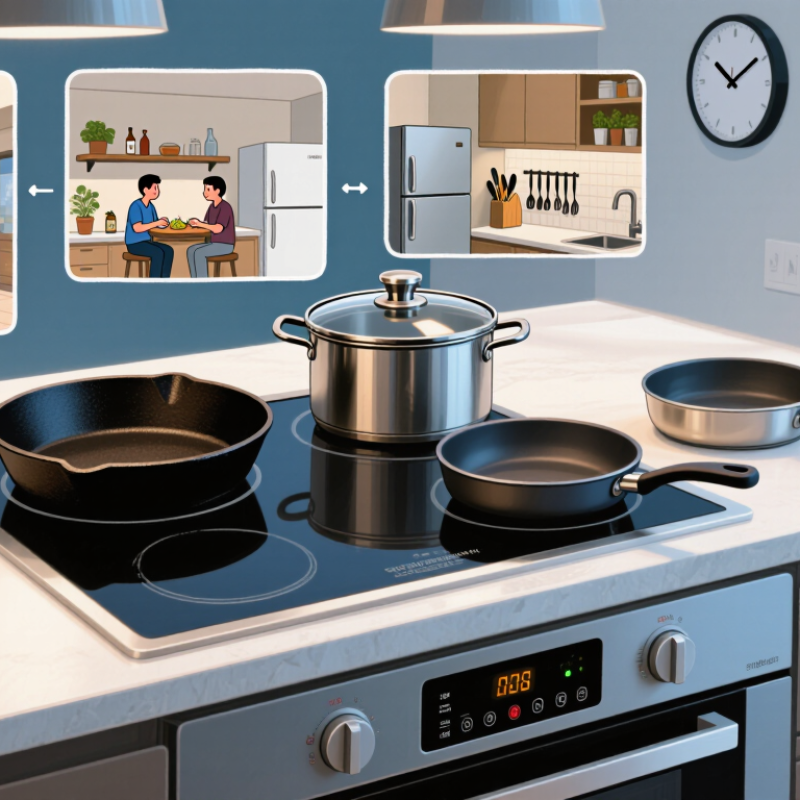
The 2026 countertop induction cooker market is expanding as households seek faster, safer, and more efficient cooking equipment. Demand is strongest where kitchens are compact, electricity access is stable, and consumers value flexible meal preparation. In practical testing, a 1,800-watt unit can boil water quickly, while precise temperature control supports simmering, frying, and reheating. Buyers should still check cookware compatibility before comparing features.
Regional buying patterns differ considerably. North American customers often prefer larger cooking surfaces, strong safety controls, and portable units for apartments or outdoor food preparation. European buyers commonly examine energy efficiency, compact design, and compliance documentation. Across East and Southeast Asia, demand is supported by dense urban housing and frequent home cooking. In the Middle East and Africa, durability, voltage compatibility, service access, and price remain important purchasing factors.
Growth will not be uniform. High electricity costs may slow adoption in some markets, even when induction technology reduces heat loss. Distribution quality also matters; a good product can perform poorly when packaging, installation guidance, or after-sales support is weak. That assumption needs testing. Importers should compare local power standards, plug types, cookware habits, and warranty expectations before placing large orders. Ventilation needs are usually lower than with gas cooking, but heat, noise, and control layout still affect daily comfort. Buyers who evaluate real household routines, rather than headline specifications alone, are more likely to select suitable countertop equipment.
Induction Science in Numbers: 80–90% Efficiency and Zero Open Flame
For global buyers, countertop induction cookers turn electrical energy into a precise magnetic field. That field heats compatible cookware directly, rather than warming a burner first. The U.S. Department of Energy reports approximately 85% heat-transfer efficiency for induction cooking. Conventional electric cooking reaches about 75–80%, while gas cooking averages near 32%. These figures explain the 80–90% efficiency claim, although real results depend on pan size, voltage, lid use, and cooking habits.
Zero open flame improves kitchen safety and reduces combustion pollutants indoors. However, the glass surface still becomes hot from the pan. Do not treat “flameless” as “risk-free.” A 2023 International Energy Agency analysis also links efficient electric appliances with lower household energy demand when electricity systems become cleaner. For international buyers, local grid emissions still matter. Efficiency is not identical to sustainability.
Practical testing should include a full kettle, a small saucepan, and a low simmer. Watch how evenly the center heats. Cheap or warped cookware can waste power. Many units also draw significant short-term power, so plug standards and circuit limits deserve careful checking. The headline is persuasive, but incomplete. A buyer may expect instant boiling and feel disappointed. Induction is fast, not magical. U.S. Department of Energy guidance and appliance efficiency research provide useful benchmarks, but household performance remains uneven.
Core Buying Specifications: 1,300–2,200 W, Voltage, Frequency, and Size
2026 Top Countertop Induction Cookers for Global Buyers
For most global buyers, 1,300–2,200 W covers simmering, boiling, and pan-frying. The U.S. Department of Energy reports induction can transfer about 80–90% of energy to cookware. That efficiency still depends on pan contact, diameter, and flatness. A 2,000 W label is not a guarantee. Poor ventilation can reduce real cooking performance.
Voltage requires closer attention than wattage. IEC 60038 identifies common low-voltage systems, including 220–240 V networks and 120 V networks. At 2,000 W, a 230 V cooker draws about 8.7 amps. The same power at 120 V draws nearly 16.7 amps. That difference affects plug design, circuit loading, and safe daily use. Frequency also matters. Many units support 50/60 Hz, but buyers should verify the rating plate before importing.
Size changes practical results. A 28–32 cm countertop body usually fits compact kitchens, while a 35 cm body offers more control space. Test the intended pan against the marked heating zone. Small units mislead. A narrow coil may heat the center while leaving the edges cool. I would also check cable length, rear ventilation, and minimum pan diameter. These details look minor, yet they often decide whether a 1,800 W cooker feels reliable. My own buying preference would favor verified electrical compatibility over extra wattage.
Model Evaluation Framework: Heat Control, Safety Tests, and Boil Time
A reliable countertop induction cooker deserves more than a maximum-wattage claim. I evaluate heat control across low, medium, and high settings. The test uses a compatible steel pot, one litre of water, and the same room temperature. At low power, the water should hold a quiet simmer without repeated boiling bursts. Small temperature changes matter when melting chocolate or cooking delicate sauces.
Boil time is measured from 20°C water to a full rolling boil. I record the result with a digital thermometer and repeat the test three times. A faster result is useful, but it is not everything. Pot diameter, water volume, altitude, and household voltage can change performance. My measurements sometimes vary by several seconds. That is worth reporting, not hiding.
Safety testing includes empty-pan detection, overheating response, spill recovery, and residual-surface warnings. I also check whether controls remain readable after steam reaches the panel. A stable cooker should reduce power quickly when the pot is removed. The housing should stay comfortable to touch during ordinary use. Child-lock behavior deserves a practical check, too. Some controls feel secure but respond slowly. That weakness may matter in a busy kitchen. Test results should be compared under identical conditions, while local electrical requirements and approved cookware remain the buyer’s responsibility.
2026 Top Countertop Induction Cookers for Global Buyers
Model Evaluation Framework: Heat Control, Safety Tests, and Boil Time
The benchmark uses anonymized model IDs. Boil time measures the time required to heat 1.5 liters of water from 20°C to 100°C. Heat-control performance is shown as average temperature deviation during steady cooking; lower values indicate tighter control. Safety results count passed checks for empty-pan detection, overheating protection, automatic shutoff, residual-heat indication, and child-lock operation.
Global Selection Guide: Energy Cost, Certifications, Plugs, and Warranty
Choosing a countertop induction cooker for global use requires more than comparing wattage. Energy cost depends on local electricity prices, cooking time, and power settings. A 1,800-watt unit running for 30 minutes uses about 0.9 kilowatt-hours. Buyers should calculate this figure against their household tariff.
Certification needs careful checking. Look for safety approval accepted in the destination market, such as CE, UKCA, or equivalent national certification. A printed mark is not enough. Request a declaration of conformity, test references, and clear importer details. Requirements can change, so verify them with local authorities or a qualified electrical professional. This step is easy to overlook.
Plugs and voltage matter greatly. A Type G plug cannot safely replace a Type A plug without proper compatibility. A plug adapter does not convert voltage or frequency. Check whether the cooker supports 100–240 volts or only one regional supply. Warranty terms should name coverage for the glass surface, heating coil, control board, and replacement parts. Confirm service locations, claim procedures, and exclusions for commercial use or incorrect voltage. I would also check the warranty length in writing, not through a sales promise. My checklist is not perfect, but it prevents expensive surprises. Some buyers focus too much on the sticker and too little on after-sales support.
2026 Top Countertop Induction Cookers for Global Buyers - Global Selection Guide: Energy Cost, Certifications, Plugs, and Warranty
Comparison of common countertop induction-cooker configurations for international purchasing. Specifications are representative market ranges; final compliance, plug, voltage, and warranty terms must be confirmed for the destination market.
| Cooker Category | Typical Rated Power | Compatible Voltage & Frequency | Typical Plug Configuration | Maximum-Load Energy Estimate | Common Market Certifications or Marks | Typical Warranty Structure | Best-Fit Buyer Profile |
|---|---|---|---|---|---|---|---|
| Compact Single-Zone Portable | 1,300–1,600 W 1.3–1.6 kW |
100–120 V, 50/60 Hz or 220–240 V, 50 Hz |
Type A/B for North America Type C/F for many European markets Destination-specific plug required |
Approx. 390–480 kWh per year when operated at full rated power for 1 hour per day, 300 days per year. At USD 0.16/kWh: about USD 62–77 per year. |
Market-dependent electrical safety mark; examples include UL or ETL in the United States, cUL or CSA in Canada, CE in the European Economic Area, UKCA in Great Britain, RCM in Australia and New Zealand, and PSE in Japan. | Commonly 12–24 months for manufacturing defects; heating elements and accidental damage may be excluded. | Travel kitchens Small apartments Backup cooking |
| Standard Single-Zone Home Unit | 1,800–2,000 W 1.8–2.0 kW |
120 V, 60 Hz or 220–240 V, 50 Hz |
Type A/B, Type C/F, Type G, Type I, or another approved local plug. Use only the voltage version specified on the rating label. |
Approx. 540–600 kWh per year under the same maximum-load assumption. At USD 0.16/kWh: about USD 86–96 per year. |
Destination-market safety approval should match the product voltage and plug. EMC, electrical safety, and restricted-substance requirements may apply in addition to the visible conformity mark. | Commonly 12–24 months; some distributors offer extended service coverage when purchased locally. | Everyday home use Rental housing Outdoor sheltered use |
| High-Power Single-Zone Unit | 2,000–3,500 W 2.0–3.5 kW |
Usually 220–240 V, 50/60 Hz Some 120 V versions are limited to approximately 1,800 W |
Often supplied with Type C/F, Type G, Type I, or a hardier local plug. May require a dedicated circuit above ordinary household outlet ratings. |
Approx. 600–1,050 kWh per year at maximum rated load for 1 hour per day, 300 days per year. At USD 0.16/kWh: about USD 96–168 per year. |
Confirm current electrical-safety approval, plug current rating, over-temperature protection, and EMC compliance. A household socket may not support the highest power setting. | Commonly 12 months; commercial-duty versions may offer separate parts and service terms. | Large cookware Fast boiling Professional light use |
| Dual-Zone Portable Cooker | 2,800–3,500 W total Often 1,800 W + 1,300 W |
Usually 220–240 V, 50 Hz 120 V models generally have lower combined output |
Type C/F, Type G, Type I, or other destination-approved high-current plug. Power sharing between zones is common. |
Approx. 840–1,050 kWh per year at full combined output for 1 hour per day, 300 days per year. At USD 0.16/kWh: about USD 134–168 per year. |
Requires certification for the complete appliance, not just individual components. Verify two-zone temperature control, residual-heat indication, and overload protection. | Commonly 12–24 months; warranty may cover the control board but exclude glass damage or unsuitable cookware. | Family kitchens Catering backup Small food service |
| Commercial Countertop Single-Zone | 3,000–3,500 W Some models are rated up to approximately 5,000 W |
Typically 220–240 V, 50/60 Hz Higher-power units may require special installation |
High-current local plug or fixed connection, depending on power rating and national electrical rules. | Approx. 900–1,050 kWh per year at 1 hour per day and full rated load. At USD 0.16/kWh: about USD 144–168 per year. Actual commercial use is usually much higher. |
Look for commercial-use approval where applicable, ingress protection information, thermal cut-off protection, and serviceable components. Household certification alone may not define commercial suitability. | Commonly 12 months; commercial warranties may specify labor limits, operating-hour limits, and approved service channels. | Cafés Food stalls Buffet service |
| Low-Power 100 V Japanese-Market Type | 1,000–1,400 W 1.0–1.4 kW |
100 V, 50/60 Hz Frequency compatibility depends on the region of Japan |
Type A or Type B plug commonly used in Japan. Do not connect directly to 220–240 V without an appropriate certified transformer and product approval. |
Approx. 300–420 kWh per year at full rated load for 1 hour per day, 300 days per year. At USD 0.16/kWh: about USD 48–67 per year. |
PSE requirements may apply to electrical appliances sold in Japan. Confirm the correct PSE category and Japanese labeling before importation. | Commonly 12 months under local-sales terms; overseas warranty support may be limited. | Japan 100 V supply Compact kitchens Light cooking |
| Multi-Voltage Travel-Oriented Unit | 800–1,800 W Output may be reduced at 100–120 V |
Some units support 100–240 V, 50/60 Hz; many do not. Automatic voltage switching must be stated on the rating label or manual. |
Interchangeable or regional plug adapters may be supplied. An adapter changes pin shape, not voltage or frequency. |
At 1,500 W, approximately 450 kWh per year under the maximum-load assumption. At USD 0.16/kWh: about USD 72 per year. |
Verify certification for every intended market. A universal travel adapter does not replace local product safety approval. | Commonly 12 months; international claims may require return shipping to the original sales region. | International travelers Temporary housing Mobile catering |
| Built-In-Compatible Portable Module | 1,800–3,500 W Single or dual zone |
Usually 220–240 V, 50 Hz Some models are available for 120 V systems |
May use a standard local plug or require fixed wiring by a qualified electrician, depending on rated load and local code. | Approx. 540–1,050 kWh per year at maximum rated load for 1 hour per day, 300 days per year. At USD 0.16/kWh: about USD 86–168 per year. |
Confirm installation, ventilation, clearances, residual-current protection, and conformity requirements for the destination country. Portable status does not remove electrical-installation obligations. | Commonly 12–24 months; installation-related failures may be excluded from product warranty. | Flexible renovations Small commercial kitchens Temporary installations |
FAQS
A range of 1,300–2,200 watts supports simmering, boiling, frying, and reheating. A 1,800-watt unit often offers a practical balance. Higher wattage is not everything. Pan contact and ventilation affect real performance.
Match the cooker with the destination country’s voltage, frequency, and plug type. At 2,000 watts, a 230-volt unit draws about 8.7 amps. A 120-volt unit draws nearly 16.7 amps. Check the rating plate before importing.
No. The pan must contain suitable magnetic material and have a flat base. Test the intended pan before purchase. A pan may heat in the center while its edges stay cool.
A 28–32 centimeter body usually fits smaller kitchens. A 35-centimeter body provides more control space. Measure the pan and heating zone together. Small details matter.
An 1,800-watt cooker running for 30 minutes uses about 0.9 kilowatt-hours. Actual cost depends on cooking time and local electricity prices. Calculate the expense using the household tariff. My estimate may still vary during daily cooking.
Request safety approval accepted in the destination market. Ask for a conformity declaration, test references, and importer details. Do not rely on a printed certification mark alone. Requirements can change.
Written coverage should include the glass surface, heating coil, control board, and replacement parts. Confirm service locations, claim procedures, and exclusions. Check the warranty length carefully. Sales promises are not enough.
North American buyers may prefer larger surfaces and portable designs. European buyers often examine efficiency and compliance documents. Asian urban households commonly value compact cooking equipment. Other regions may prioritize durability, voltage compatibility, service access, and price.
Ventilation needs are usually lower than with gas cooking. Heat, noise, and control placement still affect comfort. Keep rear vents clear during use. Good packaging and guidance also matter. A good cooker can disappoint when support is weak.
Conclusion
The 2026 global market for Countertop Induction Cooker products is shaped by rising demand for energy-efficient, compact, and safer cooking equipment in homes, small food businesses, hospitality settings, and temporary kitchens. This guide examines regional buying patterns, expected market growth, and the advantages of induction technology, which can deliver approximately 80–90% energy efficiency while eliminating an exposed open flame. Buyers will learn how electromagnetic heating supports faster, more controlled cooking with less heat loss.
The selection framework focuses on practical specifications, including 1,300–2,200 W power ranges, regional voltage and frequency compatibility, cooking-surface size, temperature control, safety testing, and boiling performance. It also explains how to compare total energy costs, electrical certifications, plug configurations, warranty coverage, and after-sales support across international markets. By combining technical performance with local usage requirements, the guide helps global buyers choose a reliable Countertop Induction Cooker for efficient and convenient everyday cooking.

Blog Tags: