

Cookware Tech &
Kitchen Knowledge.
Discover expert tips, non-stick maintenance guides, and manufacturing insights.
View Catalogue
Crafting Quality
Since 1990.
Learn how Kiam engineers durable pressure cookers and appliances.
About Factory
Export News &
Market Trends.
Valuable trade resources for international kitchenware buyers and distributors.
B2B EnquiryChina has become a significant sourcing base for cookware, including the Tri-Ply Stainless Steel Kadai. These manufacturers serve restaurants, retailers, distributors, and private-label brands worldwide. Their product ranges often include different capacities, lid designs, handle styles, and surface finishes.
A quality Tri-Ply Stainless Steel Kadai usually combines stainless steel with an aluminum core. This structure supports faster heat distribution and more stable cooking performance. Buyers should inspect the base construction, wall thickness, weld quality, handle attachment, and lid fit. Induction compatibility also requires clear confirmation, not assumptions. Details matter.
Experienced sourcing teams should request material specifications, factory photographs, product samples, and recent inspection records. They should also ask how manufacturers control polishing, forming, packaging, and dimensional consistency. A reliable supplier explains these processes clearly. Independent testing can provide further confidence when food-contact performance, corrosion resistance, or thermal behavior is important.
However, no supplier profile tells the whole story. A polished catalog may not represent every production batch. Samples can look excellent while mass production needs closer monitoring. This is where careful communication and third-party inspection become valuable. The strongest Chinese manufacturers combine practical engineering, export experience, responsive service, and transparent documentation. Yet buyers should compare evidence rather than rely on impressive claims. This guide examines leading manufacturers through product quality, customization capability, production experience, compliance awareness, and customer support. It also recognizes a simple truth: even good cookware suppliers may have weaknesses that deserve discussion.
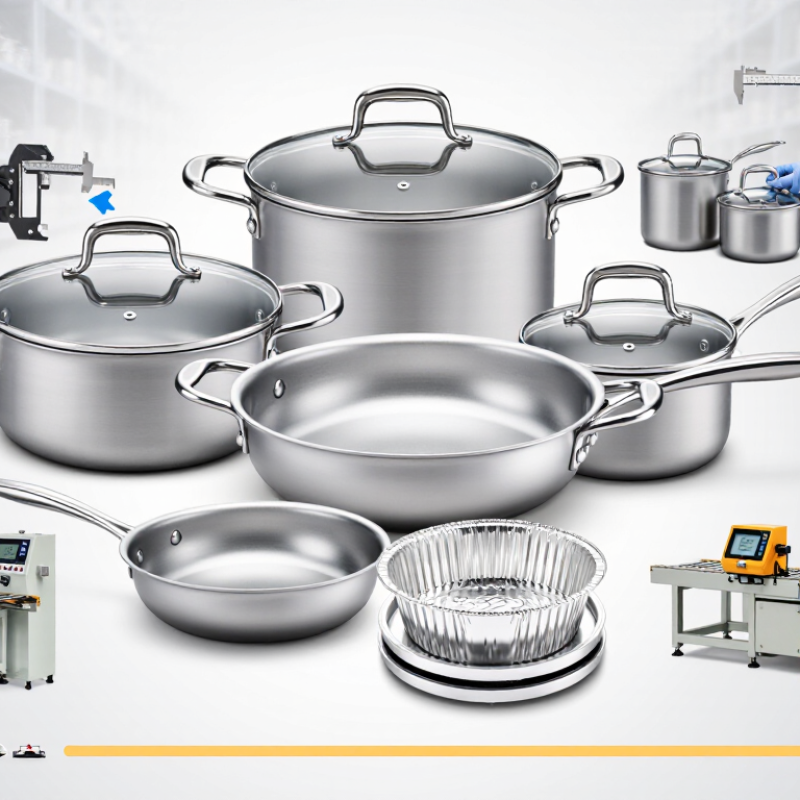
What Defines a Top Tri-Ply Stainless Steel Kadai Manufacturer in China
A top tri-ply stainless steel kadai manufacturer is defined by controlled metallurgy, not attractive catalog photography. The vessel should combine a food-contact stainless-steel interior, an aluminum heat-spreading core, and a compatible exterior layer. Material certificates should identify grade, thickness, and heat numbers. That traceability matters.
World Stainless reported 58.4 million tonnes of global crude stainless-steel production in 2023. Such scale increases material availability, but it does not guarantee cookware quality. Factory auditors should check incoming coils, laser-welded layers, rim finishing, handle strength, and base flatness. A 2023 UN Comtrade review under HS 732393 also places China among major exporters of stainless-steel household articles. Export volume, however, is only a starting signal.
Experienced buyers should request production samples after tooling approval. Inspectors can measure wall thickness, run thermal distribution tests, and examine discoloration after repeated heating cycles. Food-contact documentation should match the actual alloy, not a generic file. Packaging should protect the polished surface from scratches and moisture.
Small details reveal factory discipline. A loose handle does too.
My own checklist is not perfect. It can overlook long-term lid distortion or uneven induction contact. Therefore, reliable manufacturers welcome corrective-action reports, retain batch records, and repeat tests after process changes. Their engineers should explain failures plainly, even when the sample looked acceptable.
China Top Tri Ply Stainless Steel Kadai Manufacturers - What Defines a Top Tri-Ply Stainless Steel Kadai Manufacturer in China
| Evaluation Dimension | Typical Technical Benchmark | Why It Defines a Top Manufacturer | |
|---|---|---|---|
| Tri-Ply Construction |
Three-layer structure Stainless steel interior and exterior with an aluminum core for improved heat distribution. |
Cross-sectional drawings, material specifications, sample inspection, and production records confirming continuous layered construction rather than a simple single-wall body. | A genuine bonded multi-layer body provides more even heating and reduces hot spots during cooking. |
| Food-Contact Material |
Common grades 18/8 or 18/10 stainless steel is widely used for cookware food-contact surfaces; 18/10 contains approximately 10% nickel. |
Material certificates, grade declarations, supplier traceability, and independent alloy verification when required. | Appropriate stainless-steel grades offer corrosion resistance, durability, and a neutral cooking surface when properly manufactured. |
| Heat Distribution |
Aluminum-core function The aluminum layer should extend consistently across the cooking base and, in full tri-ply designs, through the side walls. |
Product cross-sections, thermal testing, heating-uniformity reports, and comparison of base-only versus full-body construction. | Consistent heat transfer supports better browning, lower risk of localized scorching, and more predictable cooking results. |
| Induction Compatibility |
Magnetic exterior The outer cooking surface should contain a magnetic stainless-steel layer suitable for induction cooktops. |
Induction heating tests, cooktop compatibility records, and confirmation that the stated base design matches the delivered product. | Verified compatibility allows the kadai to be sold for gas, electric, ceramic, and induction cooking where the design supports those surfaces. |
| Wall and Base Integrity |
Stable geometry The body should remain level, resist distortion, and maintain a uniform rim and base after forming and thermal processing. |
Flatness checks, wall-thickness records, rim inspection, drop or deformation testing, and finished-sample measurements. | Stable geometry improves stovetop contact, reduces wobbling, and helps preserve the product appearance during repeated use. |
| Handle and Lid Engineering |
Secure and practical fittings Handles should be firmly attached, comfortable to hold, and designed with suitable heat-clearance; lids should seat consistently. |
Handle-load tests, fastening-process records, lid-fit inspection, heat-resistance verification, and assembly quality checks. | Reliable fittings improve handling safety, reduce returns, and support a better user experience in household and commercial kitchens. |
| Surface Finish |
Clean and uniform finish Interior and exterior surfaces should be free from sharp edges, deep scratches, exposed burrs, weld contamination, and visible pits. |
Cosmetic inspection standards, polishing specifications, edge-safety checks, pass-rate records, and approval samples. | Consistent finishing improves hygiene, appearance, cleanability, and perceived product quality. |
| Manufacturing Capability |
Controlled production process Capabilities may include deep drawing, layer bonding or clad forming, CNC or mechanical trimming, polishing, welding, and assembly. |
Process flow charts, equipment lists, production capacity information, maintenance records, and in-process quality checkpoints. | Integrated process control helps maintain dimensional consistency and reduces dependence on uncontrolled subcontracting. |
| Quality Management |
Documented inspection system Incoming-material inspection, process inspection, final inspection, nonconformance handling, and corrective-action procedures. |
Quality manuals, inspection checklists, calibration records, batch traceability, audit reports, and corrective-action documentation. | A documented system makes quality repeatable across production batches instead of relying only on final visual inspection. |
| Compliance and Testing |
Market-specific compliance Testing should match the destination market and may cover food-contact safety, heavy-metal migration, corrosion resistance, and labeling requirements. |
Current third-party test reports, declarations of conformity, laboratory credentials, and reports that identify the actual product or material. | Relevant documentation lowers import risk and supports lawful sale in the target market. |
| Customization Capability |
OEM and private-label support Ability to adjust diameter, capacity, wall profile, handle style, lid design, packaging, and markings within validated limits. |
Engineering drawings, sample-development procedures, tooling ownership terms, prototype records, and packaging approval samples. | Controlled customization helps buyers create differentiated products without compromising construction or safety requirements. |
| Capacity and Delivery Control |
Repeatable order fulfillment Clear production lead times, realistic minimum order quantities, documented capacity planning, and defined shipment inspection procedures. |
Production schedules, capacity statements, historical on-time delivery data, pre-shipment inspection records, and carton-loading plans. | Reliable planning reduces stock shortages, launch delays, and unexpected logistics costs. |
| Packaging and Export Readiness |
Protection through transit Packaging should protect polished surfaces, handles, lids, and rims while meeting destination-market labeling and carton requirements. |
Packaging specifications, drop-test results where applicable, carton markings, loading photographs, and approved packing samples. | Proper export packaging reduces transit damage and supports efficient warehouse receiving and retail distribution. |
| After-Sales Support |
Responsive commercial support Written warranty terms, complaint-response procedures, spare-part or replacement policies, and root-cause analysis for quality issues. |
Warranty documents, service-level commitments, complaint records with corrective actions, and clearly assigned customer-service contacts. | Effective after-sales processes protect long-term purchasing relationships and provide a practical remedy when defects occur. |
FAQS
Reliable manufacturers control metallurgy, welding, polishing, and final inspection. They provide certificates showing steel grade, thickness, and production batch details. Traceability matters. They also explain failures clearly and repeat tests after process changes.
The inner layer should use food-contact stainless steel. A continuous aluminum core should spread heat across the base and lower sidewalls. The outer layer must suit the intended cooktop. Material documents should match the actual alloy used.
Aluminum conducts heat much faster than stainless steel. The core spreads heat beyond the burner’s center. Onions may soften across the pan instead of burning centrally. Even heating still depends on correct temperature control.
Request samples made with the same materials and tooling planned for production. Measure wall thickness, base flatness, and handle strength. Use the same burner and cooking load for three sample comparisons. Inspect discoloration after repeated heating cycles.
Check the outer layer, base flatness, and continuous contact with the cooking surface. Thermal mapping can reveal uneven heating areas. A thick base may resist warping but respond more slowly. Never rely on a catalog statement alone.
Loose handles, uneven rims, poor bonding, and scratched polishing deserve attention. Check whether lids fit evenly after heating. Inspect packaging for moisture protection and surface safeguards. Small flaws matter.
Ask for material certificates, recent test reports, factory quality procedures, and food-contact documents. The paperwork should identify the actual alloy and thickness. Independent audits can verify production claims. Generic files create uncertainty.
Review customer feedback after launch and adjust inspection points when needed. Packaging, handle temperature, lid fit, or cleaning marks may need changes. My checklist could miss long-term lid distortion. That is worth admitting.
Conclusion
China’s top Tri-Ply Stainless Steel Kadai manufacturers combine material expertise, precise engineering, and consistent production control to create cookware suited to demanding commercial and household markets. A tri-ply structure typically bonds stainless steel with a highly conductive aluminum core, helping distribute heat evenly, reduce hot spots, and improve cooking control. Reliable manufacturers manage key processes such as sheet forming, deep drawing, layer bonding, welding, polishing, handle assembly, and dimensional inspection with careful attention to detail.
When evaluating suppliers, buyers should review material specifications, thickness consistency, food-contact safety, surface quality, durability testing, production capacity, and quality management procedures. It is also important to confirm whether a manufacturer can support customized sizes, finishes, packaging, and order volumes while maintaining stable quality. By comparing technical capabilities, inspection systems, communication efficiency, lead times, and after-sales support, importers can select a Chinese manufacturer that delivers dependable Tri-Ply Stainless Steel Kadai products aligned with their market requirements.