
Kiam cookware and kitchenware blog insights
Insights & Guides

Cookware Tech &
Kitchen Knowledge.

Discover expert tips, non-stick maintenance guides, and manufacturing insights.

View Catalogue
Manufacturing excellence in cookware and pressure cookers
Manufacturing Hub

Crafting Quality
Since 1990.

Learn how Kiam engineers durable pressure cookers and appliances.

About Factory

Kiam B2B export news and industry resources
Global Trade

Export News &
Market Trends.

Valuable trade resources for international kitchenware buyers and distributors.

B2B Enquiry
0%

The global pressure cooker market is moving beyond basic aluminum models. Buyers now examine steel grade, heat distribution, safety controls, warranty coverage, and factory consistency. Fortune Business Insights estimated the global pressure cooker market at approximately USD 5.1 billion in 2023, with continued growth expected through the decade. Definitions vary, however. Some reports include electric appliances, while others focus on stovetop cookware.

That distinction matters when comparing a Tri-Ply Stainless Steel Pressure Cooker supplier. A tri-ply body usually combines stainless steel, an aluminum core, and another stainless layer. The structure spreads heat more evenly across the base. It can also reduce scorching during browning. Still, “tri-ply” is not a complete quality guarantee. Thickness, bonding precision, lid engineering, gasket durability, and pressure-release design require separate verification.

Laura Pazzaglia, founder of Hip Pressure Cooking and a recognized pressure-cooking educator, wrote, “Pressure cooking is not just about speed; it’s about flavor.” That practical view suits professional purchasing decisions. A reliable supplier should provide test records, material specifications, production photographs, and traceable quality procedures. Reports from Grand View Research also show strong consumer interest in durable, premium cookware, although market estimates differ by methodology.

The best supplier may not be the cheapest. It should deliver repeatable performance. Ask for sample testing. Inspect the handle after repeated heating. Check whether the base remains flat on a cool countertop. Small details reveal large weaknesses. Supplier comparisons can still be imperfect, because published claims often outpace independently verified evidence. This guide evaluates leading Tri-Ply Stainless Steel Pressure Cooker suppliers through product construction, certifications, manufacturing capability, customization, and long-term service support.
Top Tri Ply Stainless Steel Pressure Cooker Suppliers

What Is a Tri-Ply Stainless Steel Pressure Cooker?

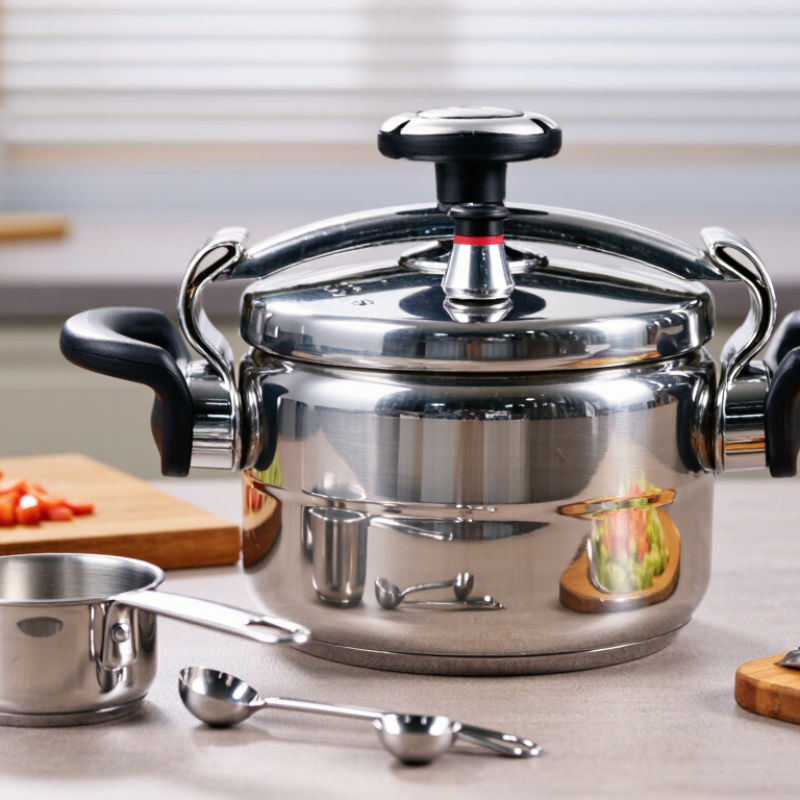
A tri-ply stainless steel pressure cooker has three bonded metal layers in its main cooking body. The inner and outer layers usually use food-grade stainless steel. An aluminum core sits between them. This core spreads heat across the base and sidewalls more evenly than single-layer steel. Fewer hot spots mean lentils, rice, and stews are less likely to scorch.

The cooker traps steam inside a sealed vessel. As pressure rises, the boiling temperature increases, helping food cook faster. A pressure indicator, locking lid, and controlled release system manage this process. In practical use, the handles should stay firm, and the lid should close without force. The base should also sit flat on the cooking surface. Small details matter.

Tri-ply does not make every cooker perfect. Some models heat slowly on induction, despite having a compatible base. Others feel heavy when filled with soup. I would check the layer construction, steel grade, gasket quality, and replacement-part availability before choosing a supplier. Clear safety instructions also show stronger manufacturing discipline. A polished exterior can look impressive, but it cannot prove even heating or reliable pressure control. Supplier claims deserve careful checking.

Key Features to Compare Among Pressure Cooker Suppliers

When comparing top tri-ply stainless steel pressure cooker suppliers, inspect construction before appearance.

A reliable tri-ply body usually combines stainless steel, an aluminum core, and stainless steel. This structure spreads heat more evenly across a gas or induction hob. Ask for cross-section photos, metal grades, and thickness records. “Tri-ply” alone proves little.

Fortune Business Insights estimated the global pressure cooker market at over USD 4 billion in 2023, with continued growth expected through 2032. That growth attracts inconsistent suppliers.

Compare pressure-control accuracy, safety-valve design, gasket life, and lid-lock testing. EN 12778 covers household pressure cookers in Europe, while relevant national standards may differ elsewhere. Request current test reports, not certificates copied from old product batches. Small detail, big risk.

Check performance data, too. A supplier should provide heating tests, pressure-retention results, and cycle testing for handles and seals. The aluminum core should remain stable after repeated heating and cooling. Ask how many cycles the gasket survives. Some suppliers avoid this question. That matters.

Replacement seals, valves, and handles should remain available for several years. Warranty terms should state exclusions clearly, including misuse and normal wear.

The U.S. Consumer Product Safety Commission repeatedly highlights the importance of tested safety features in pressurized household products. I would also compare minimum order quantities, inspection procedures, and packaging protection.

A polished sample can hide weak production control. Supplier records, batch traceability, and independent laboratory verification offer stronger evidence than confident sales language.

How to Evaluate Manufacturing Quality and Safety Standards

When evaluating tri-ply stainless steel pressure cooker suppliers, inspect manufacturing evidence, not only product photographs. A reliable supplier should explain the steel grades used for the inner, core, and outer layers. Ask for material certificates and batch traceability. The base should sit flat, without visible gaps or uneven bonding. Small defects matter.

Safety depends on controlled pressure, heat, and sealing. Request records for pressure testing, leak testing, lid-lock testing, and valve calibration. Check whether production follows recognized food-contact and pressure-equipment standards for the target market. Inspect silicone seals for consistent thickness and clear replacement guidance. Safety valves should open reliably during abnormal pressure conditions. They should not feel loose or poorly finished.

A factory audit can reveal more than a sales conversation. Look for calibrated gauges, documented inspection points, trained operators, and retained test samples. Ask how rejected units are isolated. A polished sample can mislead. One supplier I reviewed had strong welding quality but weak batch records, which required further verification. That gap did not prove unsafe production, but it reduced confidence. Request independent laboratory reports when internal documents seem incomplete. Examine carton labels, instructions, and warning text for practical clarity. The best supplier is not always the cheapest; it is the one that can repeatedly prove safe performance.

Top Tri-Ply Stainless Steel Pressure Cooker Suppliers: How to Evaluate Manufacturing Quality and Safety Standards

Thermal conductivity is an important reference when evaluating tri-ply cookware construction. Aluminum provides rapid heat transfer between stainless-steel layers, while 304 and 430 stainless steel offer corrosion resistance and structural durability. Values shown are typical room-temperature reference values in W/m·K; actual performance depends on alloy grade, thickness, bonding quality, and manufacturing consistency.

Supplier verification should also include material certificates, food-contact compliance, pressure-vessel safety testing, dimensional inspection, weld and bond quality control, traceability, and documented quality-management procedures. Thermal conductivity alone does not prove pressure-cooker safety.

Leading Regions and Types of Tri-Ply Pressure Cooker Suppliers

Tri-ply pressure cooker suppliers are concentrated across several practical regions. Asia-Pacific remains the main manufacturing hub, supported by stainless steel production, machining capacity, and export infrastructure. Grand View Research valued the global pressure cooker market at about USD 5.4 billion in 2023. Its forecast also indicates steady growth through 2030. China and India commonly serve OEM and ODM buyers, while Southeast Asian factories increasingly support contract production. European suppliers often emphasize engineering, testing, and compliance with EN 12778 requirements. North American suppliers usually focus on distribution, private-label programs, and after-sales service rather than primary production.

Supplier types differ as much as their locations. OEM factories manufacture against fixed drawings and tooling. ODM suppliers offer existing body designs, handles, valves, and packaging. Specialized stainless-steel cookware producers may provide deeper control over 18/10 steel grades, aluminum core thickness, welding, and polishing. A 2024 report from Mordor Intelligence describes Asia-Pacific as a leading regional market, although regional rankings can change with freight costs and household demand. That uncertainty matters. A large factory is not automatically a reliable pressure-cooker partner.

Tips: Request material certificates, pressure-cycle records, leak-test results, and independent laboratory reports. Check whether the tri-ply base heats evenly on your target stovetop. Ask for sample cookware before approving tooling. Inspect valve movement by hand. Small details reveal weak quality control. Forecasts are useful, but factory evidence is better.

How to Select the Right Supplier for Your Business Needs

Top Tri Ply Stainless Steel Pressure Cooker Suppliers

Choosing a supplier requires more than comparing catalog prices. Fortune Business Insights estimates the global pressure cooker market will grow from USD 4.21 billion in 2023 to USD 6.11 billion by 2032. This growth increases supplier competition, but quality can vary sharply. Request material certificates for the stainless steel, aluminum core, and food-contact surfaces. A genuine tri-ply body should distribute heat evenly, especially around the base and sidewalls. Test samples on your intended cooking equipment. Small differences become obvious during repeated heating.

Production reliability matters as much as product design. Ask for pressure-cycle testing records, leakage checks, dimensional reports, and traceable batch numbers. Suppliers should explain how they control sealing rings, safety valves, handles, and lid alignment. ISO 9001 certification can support process consistency, but it does not replace independent product testing. Check compliance with relevant pressure-cooker standards in your target market. Do not accept vague certificates.

Look closely at factory capacity and communication speed. The International Trade Centre reports that cookware trade involves complex global supply chains, making delivery planning important for importers. Confirm minimum order quantities, sample timelines, spare-part support, and corrective-action procedures. A low quotation may hide weak packaging or expensive rework. I have learned that a polished sample can mislead. Ask for production-line photographs, inspection videos, and a pre-shipment inspection clause. The supplier should welcome difficult questions. That matters.

Top Tri Ply Stainless Steel Pressure Cooker Suppliers - How to Select the Right Supplier for Your Business Needs
Evaluation Dimension Key Data to Collect Recommended Selection Requirement Verification Documents or Tests Relevant Reference
Product Construction Number of bonded layers, layer arrangement, total body thickness, base thickness, and bonding method. Confirm a genuine three-layer structure, such as stainless steel–aluminum–stainless steel, and require the supplier to disclose measured thicknesses rather than using only the term “tri-ply.” Cross-sectional sample, technical drawing, product specification sheet, and independent thickness measurement. Supplier technical documentation and incoming-quality inspection records.
Stainless Steel Grade Grade used for the cooking surface, exterior surface, and any components that contact food. Request the exact grade designation. AISI 304 is widely used for cookware; AISI 316 may offer higher corrosion resistance but should be confirmed for the intended application. Material certificate or mill test report showing chemical composition and grade identification. ASTM A240 provides chemical and mechanical requirements for stainless steel plate, sheet, and strip.
Pressure Rating Rated operating pressure, maximum allowable pressure, pressure-control method, and safety-release settings. Use a pressure rating suitable for the target market and cooking application. Do not compare suppliers using only “high pressure” claims; require numeric ratings and test conditions. Pressure test reports, calibration records, safety-valve test results, and product technical files. EN 12778 covers requirements and test methods for domestic pressure cookers in applicable markets.
Safety Systems Number and type of safety devices, lid-locking mechanism, overpressure protection, gasket-release design, and blocked-vent protection. Prioritize designs that prevent opening while pressurized and provide independent protection against excessive pressure. Each safety function should be tested separately. Safety-function test reports, failure-mode test records, assembly drawings, and user instructions. Applicable pressure-cooker safety requirements and the importing country’s product regulations.
Food-Contact Compliance Declarations and test results for stainless steel, aluminum, coatings, gaskets, valves, and other food-contact parts. Require compliance documentation for every material that can contact food or steam. Documentation should identify the exact product model and material formulation. Food-contact declaration, migration test report, material composition report, and batch traceability records. EU Regulation (EC) No. 1935/2004 and applicable U.S. FDA food-contact requirements, depending on the destination market.
Dimensional Consistency Nominal capacity, usable capacity, vessel diameter, lid fit, gasket dimensions, and base flatness. Require a controlled tolerance sheet for critical dimensions. Usable capacity should be clearly distinguished from nominal vessel capacity. First-article inspection report, dimensional inspection records, calibrated measuring equipment, and approved drawings. Internal quality specifications and the dimensional requirements defined in the purchase contract.
Heat-Source Compatibility Compatibility with gas, electric, ceramic, and induction cooktops; magnetic response of the base; heating uniformity. For induction compatibility, verify the magnetic stainless-steel base and test the finished product rather than relying only on material descriptions. Cooktop compatibility test, induction-start test, heat-distribution test, and product marking inspection. The final cooking vessel should be tested with the cooktop types listed in its instructions.
Leak and Durability Performance Pressure-holding time, repeated pressure cycles, gasket life, handle strength, valve performance, and corrosion resistance. Compare suppliers using the same test protocol and sample quantity. Require defined pass/fail criteria for leakage, deformation, and safety-device performance. Cycle-test report, hydrostatic or pressure test record, gasket aging test, handle-load test, and salt-spray or corrosion evaluation where applicable. Use the applicable market standard and a mutually approved reliability test plan.
Quality Management Quality-management certification, inspection stages, nonconformance rate, corrective-action process, and lot traceability. Prefer a documented quality system with incoming, in-process, final, and pre-shipment inspections. Certification should be verified with the issuing body. Valid ISO 9001 certificate, inspection plan, corrective-action reports, audit records, and lot-traceability samples. ISO 9001 specifies requirements for a quality-management system.
Order Capability Minimum order quantity, monthly capacity, production lead time, sample lead time, peak-season capacity, and tooling availability. Choose a supplier whose capacity matches the forecast without requiring excessive inventory. Confirm capacity using production records rather than stated maximum output alone. Capacity plan, production schedule, sample approval timeline, tooling list, and purchase-order performance history. Commercial terms should be documented in the quotation and supply agreement.
Traceability and After-Sales Support Batch coding, spare-part availability, gasket and valve replacement policy, warranty period, and complaint-response time. Require traceability from finished product to component and material batches. Define response times and replacement responsibilities before ordering. Traceability procedure, spare-parts list, warranty terms, complaint log, and service-level agreement. Best practice for supplier qualification and product-risk management.
Commercial Total Cost Unit price, tooling, packaging, testing, freight, duties, spare parts, inspection, and warranty-related costs. Compare total landed cost instead of unit price alone. Separate one-time costs from recurring costs and state all assumptions in the quotation. Itemized quotation, cost breakdown, packaging specification, freight estimate, and signed commercial terms. Use the same Incoterm, currency, quantity, and packaging assumptions for every quotation.
Supplier Score Weight Weighted score assigned to safety, compliance, quality, cost, delivery, and service. Suggested weighting: safety and compliance 30%, product quality 25%, delivery capability 15%, total cost 15%, customization 10%, after-sales service 5%. Completed supplier scorecard supported by evidence, sample results, audit findings, and approved corrective actions. Weights should be adjusted according to product risk, sales channel, and destination-market requirements.

FAQS

What materials should a reliable tri-ply pressure cooker use?

It usually combines stainless steel, an aluminum core, and stainless steel. Ask for metal grades and thickness records. “Tri-ply” proves little.

How can I verify the cooker’s layered construction?

Request cross-section photos, material certificates, and batch records. Check that the base sits flat without gaps or uneven bonding. Small defects matter.

Which safety tests should a supplier provide?

Request pressure, leak, lid-lock, valve-calibration, and pressure-retention test results. Also ask for heating and repeated-cycle data. Missing records deserve caution.

How should I assess the safety valve and lid lock?

The valve should open reliably during abnormal pressure conditions. The lid lock should prevent opening while pressure remains. It should not feel loose.

What should I check about gaskets and replacement parts?

Ask how many heating cycles the gasket survives. Confirm continued availability of seals, valves, and handles for several years. Replacement guidance should be clear.

Are certificates enough to confirm manufacturing quality?

No. Request current reports from the relevant production batch. Old certificates may not reflect present manufacturing conditions. A polished sample can mislead.

What can a factory audit reveal?

Inspect calibrated gauges, documented inspection points, trained operators, and retained samples. Ask how rejected units are isolated. This still needs checking.

Which supplier records improve confidence?

Look for batch traceability, inspection results, independent laboratory reports, and clear warranty exclusions. Strong records matter more than confident sales language.

How should I compare suppliers beyond product quality?

Compare minimum order quantities, inspection procedures, packaging protection, warranty coverage, and long-term part availability. The cheapest option may create hidden problems.

Conclusion

A Tri-Ply Stainless Steel Pressure Cooker is built with three bonded layers, typically combining stainless steel with a heat-conductive core to promote even cooking, durability, and reliable pressure performance. When comparing suppliers, businesses should examine material grade, base construction, capacity options, lid design, sealing systems, valve reliability, ergonomic handles, customization capabilities, and production consistency. Clear specifications and practical testing procedures can help distinguish dependable products from lower-quality alternatives.

Manufacturing quality should be assessed through documented inspections, pressure and leak testing, traceable materials, and compliance with applicable food-contact and product-safety requirements. Suppliers may operate in different manufacturing regions and range from specialized cookware factories to large-scale household goods producers. The right choice depends on order volume, target market, packaging needs, delivery capacity, quality-control expectations, and after-sales communication. A supplier that combines stable production, transparent documentation, responsive service, and flexible customization can provide a safer and more consistent solution for long-term business cooperation.

Amelia

Amelia

Amelia is a professional marketing specialist with a deep understanding of the company’s products, customer needs, and evolving market trends. As a dedicated contributor to the company’s website, she regularly creates informative blog articles that explain product features, practical applications,......