
Featured CE Certified Cookware Portfolio
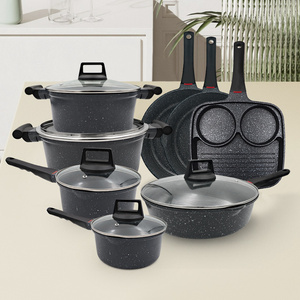
Explore our export-grade commercial and retail cookware lines. Manufactured under strict ISO quality management systems and tested to European CE, EU 1935/2004, and LFGB food contact standards.

1. B2B Whitepaper: Regulatory Compliance & Metallurgical Engineering in CE Certified Cookware
In the evolving global cookware supply chain, securing a reliable, high-capacity CE certified nonstick cookware manufacturer is paramount for B2B importers, commercial kitchen suppliers, and retail chain buyers. The European Union’s regulatory landscape for food contact materials (FCM) has transitioned from standard quality assurance to stringent biochemical safety and structural durability requirements. This whitepaper establishes the engineering standards, material science, and supply chain controls required to comply with European Directive 2001/95/EC (General Product Safety), EN 12983-1 (Domestic Cookware Safety), EU Regulation (EC) No 1935/2004, and the German LFGB framework.
Core Procurement Insight: Nonstick cookware imported into European and North American markets must pass strict abrasion, adhesion, and chemical migration thresholds. Sourcing from certified manufacturers with integrated die-casting, automated coating lines, and spectro-analysis guarantees lower return rates and zero customs hold-ups.
1.1 Understanding CE Marking & EN 12983-1 Engineering Parameters
The CE mark on nonstick cookware is not merely a trading stamp; it represents verified structural integrity under extreme thermal stress and cyclic mechanical loads. Under EN 12983-1 standards, commercial nonstick frying pans and cookware sets undergo rigorous laboratory trials including:
Handle Torque & Fatigue Testing
Handles must withstand 15,000 bending cycles under full volumetric weight loads without rivet looseness or structural degradation of the thermal isolation junction.
Thermal Shock Resistance
Rapid cooling cycles from 250°C to 20°C ambient water immersion without coating delamination, substrate warping, or micro-cracking across the nonstick matrix.
Base Concavity & Thermal Flatness
Maintaining bottom flatness tolerance within 0.6% of the diameter at cooking temperatures to optimize magnetic coupling efficiency on high-power induction hobs.
2. Technical Comparison Matrix: Nonstick Coating Technologies
Modern B2B buyers must evaluate the trade-offs between coating formulations, operational lifespans, thermal efficiency, and regulatory compliance. Below is a comparative performance evaluation based on industrial laboratory testing data.
| Coating / Substrate System | Coating Thickness (µm) | Abrasion Resistance (BS 7069 Cycles) | Max Thermal Resistance | PFAS / PFOA Status | Primary Application Target |
|---|---|---|---|---|---|
| 3-Layer PTFE Fluoropolymer | 35 – 45 µm | > 25,000 Cycles | 260°C (500°F) | 100% PFOA-Free | High-Volume Commercial Frying Pans |
| Sol-Gel Silicon Matrix (Ceramic) | 30 – 40 µm | > 15,000 Cycles | 450°C (842°F) | 100% PFAS/PTFE-Free | Eco-Conscious Retail & Specialty Cooking |
| Plasma-Sprayed Titanium Reinforced | 45 – 55 µm | > 50,000 Cycles | 280°C (536°F) | 100% PFOA-Free | Heavy-Duty Restaurant Kitchens |
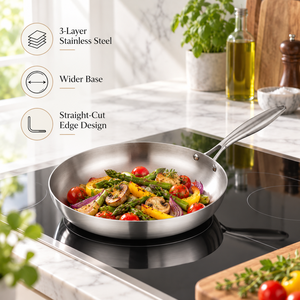
| Tri-Ply Clad (SS304/Alu/SS430) | Non-Coated / Polished | Structural Metallic Limit | 600°C (1112°F) | Naturally Chemical-Free | Intensive Commercial Sautéing & Deglazing |
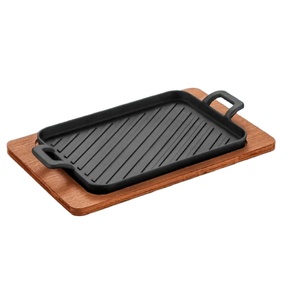
| Pre-Seasoned Cast Iron | Polymerized Oil Film | Self-Regenerating Matrix | 500°C (932°F) | 100% Natural Organic | Searing Steaks, Barbecue & Oven Baking |
3. Integrated Manufacturing Infrastructure & Enterprise Advantages
Extending across three decades of manufacturing excellence since 1990, Kiam Metal Industries Limited has positioned itself as Bangladesh’s flagship kitchenware manufacturer and a world-class OEM/ODM supplier. Operating out of the sprawling BSCIC Industrial Estate in Kushtia, our industrial complex integrates precision smelting, die-casting, cold forging, automated nonstick coating, and rigorous quality inspection under one roof.
High-Pressure Die-Casting (HPDC)
Utilizing high-tonnage cold chamber die-casting machinery producing dense A380/ADC12 aluminum alloy bodies with zero gas porosity, preventing base distortion and guaranteeing optimal heat distribution.
Automated Spray Robotics
Reciprocating multi-axis robotic spraying cells apply primer, mid-coat, and top-coat layers within exact micrometric tolerances, followed by high-temperature infrared curing tunnels.
Tariff-Advantaged Export Hub
Exporting directly from Bangladesh offers international buyers favorable tariff structures and GSP trade benefits across Europe, North America, and emerging markets, reducing landed procurement costs.
4. 2025–2030 Global Sourcing Trends in the Cookware Sector
Strategic B2B procurement requires anticipating regulatory transitions, material shortages, and shifts in consumer culinary habits. Over the next decade, three core vectors will redefine global cookware manufacturing and distribution:
4.1 The Regulatory Phase-Out of Fluorinated Polymers (PFAS / PFOA)
Legislative proposals by the European Chemicals Agency (ECHA) and the US EPA are expediting the phase-out of all per- and polyfluoroalkyl substances (PFAS). Sourcing partners must transition to inorganic ceramic nonstick matrices (Sol-Gel technology) or hard-anodized and tri-ply stainless steel alternatives to mitigate future supply chain blockage and compliance liability.
4.2 High-Efficiency Induction Compatibility
With the global transition toward energy-efficient electric and induction cooking in both commercial kitchens and residential homes, traditional plain aluminum cookware is rapidly losing market share. Modern nonstick cookware must incorporate impact-bonded AISI 430 stainless steel base plates to ensure high magnetic permeability and universal induction hob responsiveness.
4.3 Sustainable Metallurgical Recycling & Circular Sourcing
Enterprise buyers are increasingly demanding zero-carbon manufacturing footprints. Key procurement criteria now include the integration of 100% recycled post-industrial aluminum alloys, eco-friendly water-based nonstick coatings, and plastic-free recyclable FSC packaging.
5. Frequently Asked Questions (FAQ) for B2B Cookware Procurement
Clear responses to common technical, regulatory, and logistics queries raised by enterprise procurement officers and distributors.
Partner with a World-Class CE Certified Cookware Manufacturer
Elevate your product portfolio with factory-direct pricing, guaranteed European compliance, and customized OEM solutions backed by 34+ years of industrial excellence.