
Featured Commercial & Industrial Cookware Portfolio
Engineered for High-Yield Commercial Kitchens, Hotel Chains, and Global Wholesale Distribution
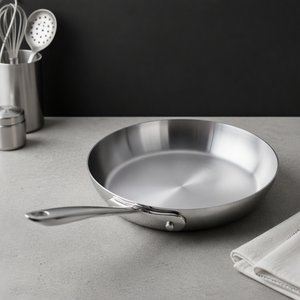
Wholesale 201 Stainless Steel Heavy-Duty Commercial Pan (3.0mm Thickness)
Precision-engineered with 3.0mm ultra-thick food-grade 201 stainless steel. Designed for heavy restaurant usage, offering rapid thermal dispersion and deformation resistance.
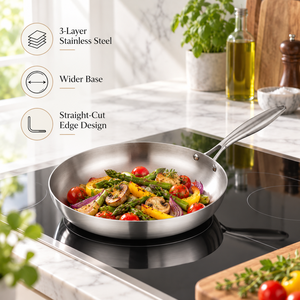
Professional 3-Ply Tri-Ply Stainless Steel Frying Pan with Wide Base
Full clad tri-ply cladding (304 SS + Aluminum Core + 430 Magnetic SS) ensuring 360-degree wall heating. Features ergonomic cool-grip handles and straight-cut drip-free rims.
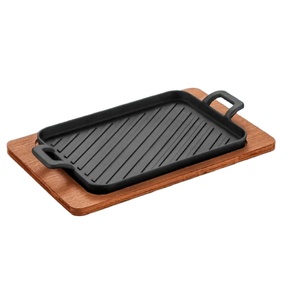
Cast Iron Rectangular Double-Handle Commercial Induction Searing Cooker
High-density grey iron casting with high heat retention capacity. Fully optimized for high-power commercial induction cooktops, steak roasting, and food service operations.
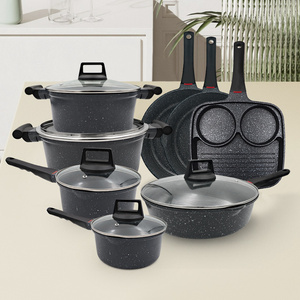
SANLANG Wholesale Non-Stick Die-Cast Aluminium Cookware Set
Heavy-gauge die-cast ADC12 aluminum body integrated with multi-layer organic ceramic non-stick coating. Includes soft-touch thermal sensing handles for safety control.
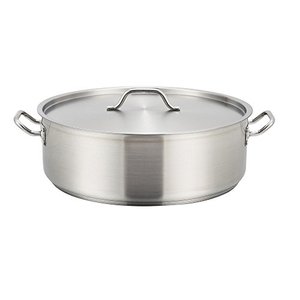
NSF Listed Commercial Electric Stainless Steel Mini Cooking Pot
Certified for commercial sanitary standards (NSF/ANSI). Built with dual-stage thermal limiters, food-grade 304 seamless liner, and micro-switch boiling sensors.
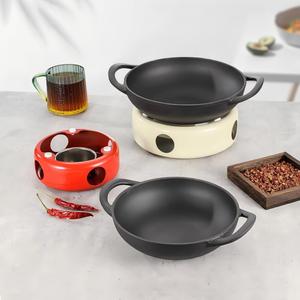
Commercial Cast-Iron Retro Stir-Fry Wok & Alcohol-Fueled Dry-Pot Vessel
Traditional hand-finished cast iron cookware engineered for high-heat wok hei stir-frying and specialty table-side alcohol heating units in commercial Asian dining establishments.
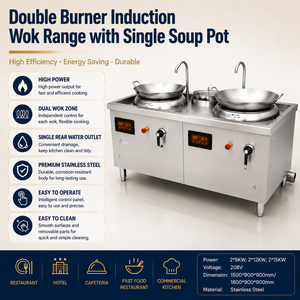
Commercial Heavy-Duty Wok Range 2*12KW ETL Induction Cooker System
Dual-burner 24KW ultra-high power commercial induction soup range. ETL sanitation certified, featuring German Infineon IGBT modules and 92% energy efficiency rating.
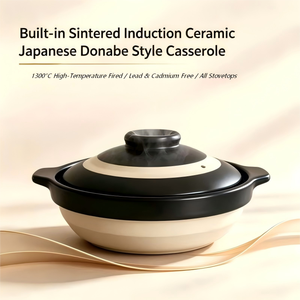
Japanese Style Handmade Ceramic Induction High-Temperature Pot Set
Crafted from thermal-shock resistant Spodumene ceramic minerals (resistant up to 650°C temperature deltas). Bottom magnetic thermal coating enables direct induction range compatibility.
Executive Summary: The China Rice Cooker Manufacturing Ecosystem
A Deep-Dive Technical Blueprint for International Importers, Brands, and Commercial Kitchen Suppliers
Global Sourcing Intelligence Brief
As of 2025, China manufactures over 78% of the global supply of electric rice cookers and commercial multi-cookers. Centralized industrial clusters across Guangdong (Shunde, Zhongshan, Lianjiang) and Zhejiang (Cixi, Ningbo) provide unparalleled integration—enabling raw aluminum smelting, die-casting, PCB micro-code development, magnetic coil winding, and certified laboratory testing within tightly localized supply radii. Modern international sourcing requires moving beyond unit price negotiation to evaluate Thermal Dynamic Efficiency, Fuzzy Logic Algorithm Tuning, and PFAS/PFOA Regulatory Compliance.
Manufacturing Capacity & Cluster Dynamics
China's rice cooker industry operates on highly specialized OEM/ODM tiers. Premier tier-1 factories utilize fully automated robotic stamping, continuous tunnel spray coating, and AI-assisted visual inspection lines capable of outputting over 500,000 units monthly per factory floor with scrap rates under 0.05%.
Global Safety Certification Protocols
Top-tier suppliers comply with stringent international standards including ETL, NSF/ANSI 4, CE, GS, CB, RoHS, REACH, and FDA/LFGB food contact safety guidelines, reducing customs clearance barriers for North American, European, and Asian markets.
Energy Efficiency & Eco Engineering
Modern smart cookers integrate high-efficiency IH coils and standby power management microchips achieving European Energy-Related Products (ErP) Lot 6 compliance with less than 0.5W standby energy consumption.
Factory Benchmark Metrics & Industrial Scale
Quantifiable Capabilities Derived from 34+ Years of Manufacturing Leadership
Technological Innovations Driving the Future of Rice Cookers
Key Engineering Breakthroughs Redefining Commercial and Domestic Kitchen Equipment
1. Multi-Phase Electromagnetic Induction Heating (IH)
Traditional electric rice cookers rely on a bottom heating plate that transfers thermal energy via conduction through a mechanical spring sensor. This creates vertical thermal gradients, resulting in uneven moisture retention and localized scorching.
Modern Chinese OEM factories have revolutionized cooking consistency with 3D Dual-Band Electromagnetic Induction (IH). By wrapping high-frequency copper coils (operating between 20kHz and 35kHz) around the entire lower and lateral sides of the vessel, magnetic flux lines directly excite eddy currents inside the ferromagnetic inner pot lining. This achieves instantaneous heating rates, generating heat directly within the vessel wall itself with thermal efficiency exceeding 90%.
2. Microprocessor PID Controllers & Fuzzy Logic Algorithms
Next-generation rice cookers are no longer simple bi-metallic switch devices; they are sophisticated thermal computers governed by 32-bit micro-controllers utilizing Proportional-Integral-Derivative (PID) thermal feedback loops.
Advanced Fuzzy Logic algorithms dynamically regulate a 7-stage cooking profile: Pre-soaking (45°C) → Quick Heating → High-Temp Boiling (100°C) → Micro-Pressure Gelatinization (1.2 atm) → Steam Venting → Moisture Absorption → Thermal Preservation (73°C). This ensures optimal alpha-starch breakdown, delivering perfect grain texture regardless of rice variety (Basmati, Jasmine, Koshihikari, or Brown Rice).
3. Advanced Metallurgy & Multi-Clad Inner Pot Engineering
The heart of cooking performance lies in the material science of the inner cooking liner. OEM/ODM suppliers now offer up to 8-layer composite vessel structures tailored to budget and performance requirements:
- Layer 1 (Food Contact): Sol-Gel Silica Ceramic or Diamond-infused Non-Stick Matrix.
- Layer 2 & 3: Primer and Wear-Resistant Ceramic Sealer Coat.
- Layer 4: High-Purity ADC12 Die-Cast Aluminum Alloy for rapid lateral thermal distribution.
- Layer 5 & 6: Anodized Aluminum Oxide Bonding layer.
- Layer 7 & 8 (Exterior Base): 430 Stainless Steel magnetic flux conductor for IH compatibility.
4. Eco-Friendly & PFAS-Free Coating Transitions
With tightening global chemical regulations (such as Europe's REACH restrictor list and US state-level PFAS bans), Chinese factories are pivoting heavily toward organic ceramic and glass-like silane non-stick formulations.
Modern ceramic coatings are cured at 400°C, forming an inorganic silica matrix completely free of PTFE, PFOA, lead, and cadmium. These coatings achieve pencil hardness ratings of 9H (ISO 15184 standard) and withstand over 50,000 continuous abrasion cycles under standard ASTM D2486 testing protocols.
Global B2B Sourcing Trends & OEM/ODM Procurement Strategies
How Enterprise Buyers and Brand Owners Optimize Their Supply Chains for Maximum Profitability and Risk Reduction
Custom CMF (Color, Material, Finish) Flexibility
B2B buyers are demanding modular mold designs that allow customizable exterior plastic housings (matte ABS, brushed stainless steel, or retro enamel finishes), touch LCD screens, localized language button overlay panels, and regional plug variations (UL, VDE, BS, SAA) without high tooling overheads.
Rigorous Factory Audit Protocols
Leading procurement groups employ 3rd-party audit agencies (SGS, TÜV Rheinland, Intertek) to perform on-site factory audits verifying ISO 9001 QMS, BSCI social compliance, automated incoming material inspection (IQC), in-line process control (IPQC), and final outbound auditing (FQA) under standard MIL-STD-105E / ISO 2859-1 AQL levels.
CKD & SKD Supply Chain Logistics
To mitigate import tariffs in emerging market regions (Latin America, Southeast Asia, Africa), top manufacturers offer Complete Knock-Down (CKD) and Semi Knock-Down (SKD) shipment options, providing complete assembly schematics, testing jigs, and component breakdown kits.
Why Partner With China’s Leading Rice Cooker Manufacturers?
Unmatched Scale, Precision Engineering, and Comprehensive B2B Export Support
Integrated Production Ecosystem
From raw sheet metal shearing, deep-draw aluminum pressing, precision die-casting, and injection molding to surface coating spray lines and PCB surface-mount technology (SMT) assembly, key Chinese manufacturing plants maintain complete in-house control over the entire value chain. This integration ensures strict quality consistency, reduced production lead times (typically 30–45 days), and competitive unit economics.
Dedicated R&D and Prototyping
Premier ODM suppliers employ dedicated teams of industrial designers, thermal engineers, and embedded software developers. Utilizing 3D CAD modeling, finite element thermal simulation (ANSYS FEA), and rapid 3D printing, custom functional working prototypes can be developed within 14 business days, significantly accelerating product launch schedules for international brands.
Frequently Asked Questions (B2B Procurement FAQ)
Essential Insights for Sourcing Managers, Import Agents, and OEM Brand Buyers
Ready to Optimize Your Rice Cooker & Cookware Supply Chain?
Contact our senior engineering and export consultation team today for custom product catalogs, factory audit reports, technical engineering drawings, and direct factory quotation pricing.