
Featured Commercial Cookware Inventory
Engineered for high-volume commercial kitchens, hotel foodservice, and enterprise culinary operations. Direct factory wholesale pricing.
Industrial Scale & OEM/ODM Manufacturing Capabilities
Leveraging over 34 years of metallurgical expertise, state-of-the-art automated production, and world-class quality management to supply global procurement networks.
As a leading titan among China top commercial cookware manufacturers and factories, our enterprise operates across expansive industrial manufacturing complexes equipped with high-tonnage hydraulic presses, fully automated robotic polishing lines, multi-layer PTFE/ceramic spray booths, and specialized metallurgical laboratories. Established in 1990, our manufacturing infrastructure bridges three decades of traditional cookware craftsmanship with cutting-edge German and Japanese automated stamping and laser-welding technology.
Our OEM/ODM B2B capabilities support global brands, commercial kitchen equipment importers, and hospitality supply chains across North America, Europe, the Middle East, and Southeast Asia. With strict adherence to international safety frameworks including NSF International, ETL Intertek, FDA, LFGB, and ISO 9001:2015 quality management systems, every vessel, frypan, pressure cooker, and commercial induction range produced in our facilities guarantees exceptional mechanical durability, food safety, and thermal efficiency under severe continuous commercial usage.
Precision Cladding & Metallurgy
Proprietary multi-layer bonding technology combining 304/316 food-grade stainless steel with high-purity aluminum cores for zero-hotspot heat dissemination.
Custom OEM/ODM Tooling
In-house mold design and CAD fabrication allowing rapid prototyping within 15 days, customized handle ergonomics, and tailored base dimensions.
Rigorous QA & Compliance
Every batch undergoes spectral metal composition testing, cross-hatch adhesion verification (ASTM D3359), thermal shock, and pressure burst testing.
Commercial Cookware Engineering & Metallurgical Breakdown
A deep technical comparative analysis for professional B2B procurement officers and kitchen equipment importers.
1. Tri-Ply Clad Stainless Steel vs. Heavy-Gauge Single Layer (201 / 304 / 316)
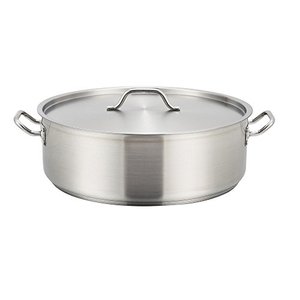
In high-intensity commercial foodservice operations, thermal conductivity and mechanical rigidity dictate pan lifespan and cooking precision. Standard single-layer stainless cookware—such as budget-focused 3.0mm 201-grade stainless steel pans—provides high tensile strength and affordability for high-wear environments like casual dining outlets. However, single-layer steel exhibits low thermal conductivity (approx. 15 W/m·K), leading to scorching and localized hotspots.
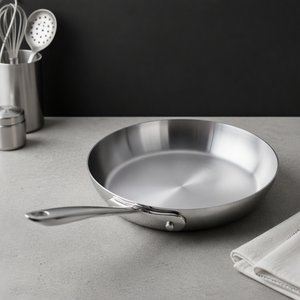
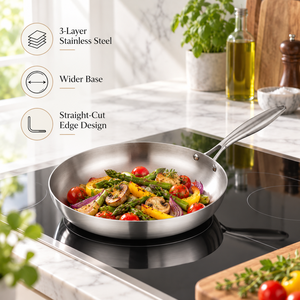
To overcome thermal bottlenecks, our factories engineer Professional 3-Ply Clad Stainless Steel Cookware. This composite structure sandwiching an inner core of 1050-grade pure aluminum (thermal conductivity approx. 200 W/m·K) between an interior contact layer of food-grade SS304/SS316 and an exterior magnetic SS430 layer creates an instantaneous, uniform heat dispersion envelope across the bottom and side walls. Straight-cut reinforced rims and elevated handle clearance prevent thermal deformation under continuous 300°C burner contact.
2. Heavy-Duty Cast Iron & Korean Commercial Electric Systems
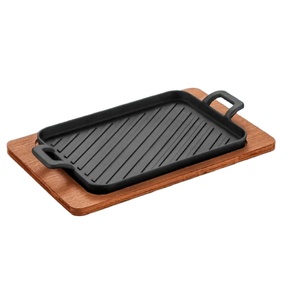
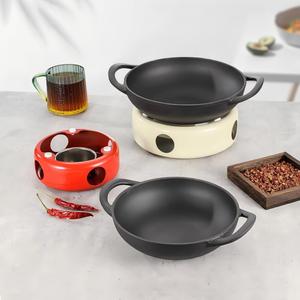
For applications demanding high thermal mass—such as steak searing, Korean BBQ, and slow-cooked braises—Commercial Cast-Iron Rectangular and Round Cookware remains unmatched. Cast iron possesses an exceptionally high specific heat capacity, retaining energy and preventing pan temperature drops when cold raw proteins touch the cooking surface. Modern Chinese commercial foundries utilize automated DISAMATIC sand-molding lines to produce cast iron cookware with ultra-dense microstructures, dual ergonomic loop handles, and multi-fuel compatibility (gas, charcoal, induction, or alcohol gel burners).
Furthermore, compact table-side restaurant concepts utilize specialized NSF Listed Korean Commercial Electric Mini Cooking Pots. These integrated stainless steel units feature precise electronic thermal sensors, rapid boil elements, and double-walled cool-touch insulation for safe front-of-house buffet and hotpot service.
3. High-Power Commercial Induction Range Engineering (ETL/NSF Certified)
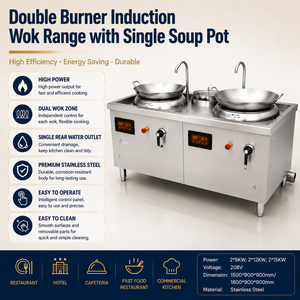
Modern high-efficiency commercial kitchens are rapidly phasing out atmospheric gas burners in favor of high-kilowatt induction technology. Our flagship 2*12KW ETL Certified Commercial Wok Ranges represent the pinnacle of commercial kitchen electrification. Operating at 90%+ thermal energy conversion efficiency (compared to 35-40% for atmospheric gas woks), these units feature heavy-gauge concave micro-crystalline glass ceramic surfaces, dual 12,000-Watt high-frequency induction coils, forced air-cooling channels, and real-time IGBT overheat protection modules.
4. Non-Stick Die-Cast Aluminum & High-Temperature Ceramic Ware
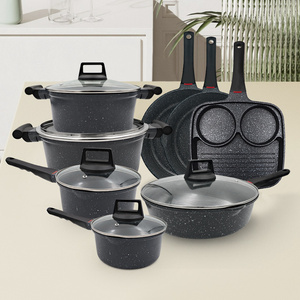
For high-volume delicate items such as eggs, fish fillets, and delicate sauces, Die-Cast Aluminum Cookware Sets offer superior structural rigidity over stamped aluminum. Utilizing high-pressure die casting (HPDC) machines, molten aluminum alloy (ADC12) is injected into hardened steel dies at high velocity, creating thick 4.5mm to 6.0mm bases that resist warping under extreme thermal shocks. Coated with multi-layer PFOA/PFAS-free ceramic matrix coatings reinforced with titanium or diamond particles, these pans achieve superior abrasion resistance under NSF commercial wear testing benchmarks.
| Cookware Category | Core Material & Construction | Thermal Conductivity | Durability Benchmark | Ideal Commercial Application |
|---|---|---|---|---|
| Tri-Ply Stainless Steel | SS304 + Aluminum 1050 + SS430 Clad | High (~180 W/m·K) | Extreme (Lifelong Heavy Commercial Use) | Professional Sautéing, Deglazing, Sauce Prep |
| Heavy-Gauge SS201 (3.0mm) | Single Layer High-Manganese Steel | Low (~15 W/m·K) | High Mechanical Strength, Dent-Resistant | High-Volume Fast Food, Budget Wholesale |
| Commercial Cast Iron | Gray Cast Iron (GG20 Alloy) | Moderate (~50 W/m·K) | Immense Mass / Indestructible Structure | Steak Searing, Sizzling Plates, Korean BBQ |
| Die-Cast Aluminum | HPDC ADC12 Alloy + PTFE/Ceramic | Very High (~200 W/m·K) | High Rigidity / Anti-Warping Base | Egg Prep, Delicate Seafood, Non-Stick Buffet |
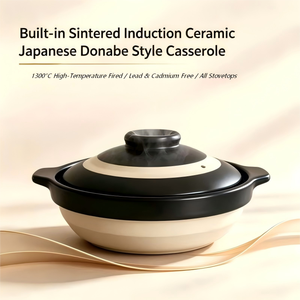
| Commercial Ceramic Pot | Spodumene Reinforced Clay | Low-Moderate (High Heat Retention) | Thermal Shock Resistant (up to 800°C) | Japanese Donabe, Claypot Rice, Slow Stews |
| ETL Induction Wok System | Copper Induction Coils + Glass Ceramic | Direct Electromagnetic Transfer | Industrial Grade Solid-State Circuitry | Heavy Commercial Stir-Fry & Soup Lines |
Future Procurement & Technological Trends in Commercial Cookware
Key macro shifts transforming B2B cookware sourcing, global compliance standards, and commercial kitchen design over the next decade.
1. Kitchen Electrification & Full Induction Compatibility
Global municipal regulations banning commercial gas hookups in new building developments are accelerating the transition toward 100% induction-compatible cookware. Commercial buyers must prioritize full-encapsulation magnetic bottoms (SS430 caps or tri-ply clad structures) to ensure peak induction responsiveness and energy efficiency.
2. Transition to PFAS-Free Sol-Gel Ceramic Coatings
Environmental protection agencies in Europe and North America are tightening restrictions on traditional PTFE coatings containing fluorinated compounds. Modern B2B buyers are migrating toward inorganic, silica-based Sol-Gel ceramic coatings capable of withstanding temperatures up to 450°C without degassing hazardous fumes.
3. Integrated IoT Thermal Monitoring & Smart Cookware
Next-generation commercial cooking pots and commercial electric ranges are integrating RFID chips and Bluetooth temperature sensors embedded within handles or bases. This allows automated kitchen systems (KDS) to track exact cooking temperatures, maintain precise HACCP food safety logs, and prevent thermal boil-overs.
4. Modular Nesting & Ergonomic Weight Reduction
With commercial real estate costs rising, restaurant kitchens require space-efficient, stackable cookware systems. OEM engineering focuses on specialized handle offsets and removable stay-cool handle mechanisms that allow 50% space savings during storage while reducing worker fatigue during high-volume shifts.
B2B Sourcing Guide: Auditing a Chinese Commercial Cookware Factory
Critical quality criteria and factory audit checklists for professional international buyers.
Selecting a top-tier commercial cookware manufacturer in China requires evaluating technical qualifications beyond standard unit cost. Procurement teams must scrutinize factory production infrastructure, metallurgical verification processes, and international regulatory certifications:
A. Spectrometric Material Verification
Ensure the factory utilizes X-ray Fluorescence (XRF) spectrometers to verify Nickel (8-10%) and Chromium (18-20%) ratios in SS304 steel batches to prevent premature rust and chemical pitting under acidic food exposure.
B. Cladding Bond Strength Testing
Tri-ply cookware must undergo ultrasonic non-destructive testing and thermal cycle quenching (heating to 350°C and plunging into cold water) to ensure zero delamination between the steel and aluminum layers.
C. Handle Weld Shear Stress Testing
Commercial riveted or spot-welded handles must withstand static loads exceeding 100 kg and dynamic fatigue testing over 10,000 cycles to guarantee worker safety in high-temp kitchen environments.
Commercial Sourcing & Procurement FAQ
Expert answers to common buyer questions regarding custom OEM orders, minimum quantities, certifications, and global shipping logistics.
Accelerate Your Commercial Cookware Procurement Today
Connect directly with our engineering and B2B export specialists to receive detailed factory catalogs, custom OEM project quotations, and wholesale volume pricing schedules.
Get a Quote