
Featured Commercial Cooking Kadais & Export Cookware
Direct factory supply lines engineered for high-volume foodservice, commercial hospitality, and global retail distribution networks. Fully compliant with NSF, ETL, FDA, and LFGB food-safety benchmarks.
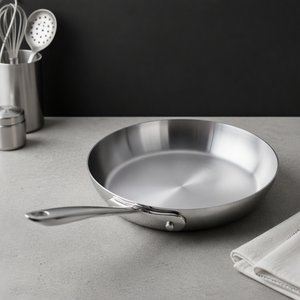
Wholesale 201 Stainless Steel Pan Stainless Pans Steel Frying Pan 3.0mm Thickness for Restaurant Use
Heavy-gauge 3.0mm AISI 201 stainless steel build offering exceptional resistance to warping under thermal stress. Optimized for high-heat commercial restaurant fry stations.
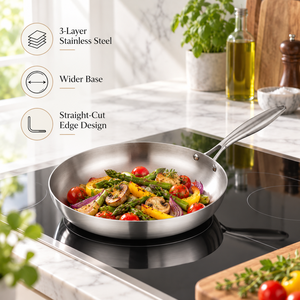
Professional 3 Ply Stainless Steel Frying Pan Wide Base Straight Cut Rim Handle Height for Commercial Kitchen Cooking
3-Ply full cladding (SS304 interior + Aluminum core + SS430 induction exterior). Engineered with straight-cut drip-free rims and ergonomic stay-cool hollow handles.
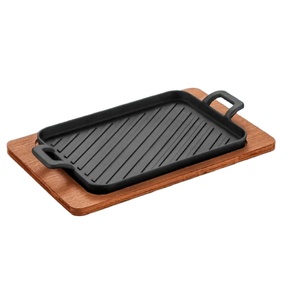
Cast Iron Rectangular Double-Handle Induction Cooker Roasted Meat Steak Commercial Barbecue Cookware Cast Iron Cooking
High-density cast iron composition for superior thermal mass and sizzle retention. Pre-seasoned non-toxic vegetable oil coating compatible with induction griddles.
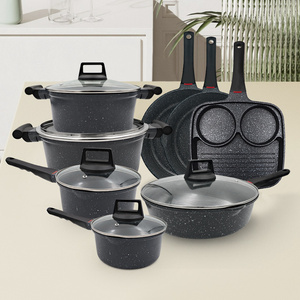
SANLANG Wholesale Non Stick Pan Induction Cookware Sets Pots Die Cast Aluminium Cookware Set With Temperature Control Handle
Pressure die-cast aluminum body with integrated magnetic thermal induction disk. Features silicone thermochromic heat-sensor indicators integrated into soft-touch handles.
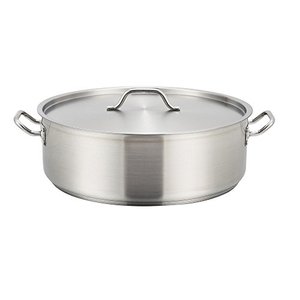
NSF Listed Korean Commercial Electric Stainless Steel Mini Cooking Pot for Restaurant
NSF Sanitation certified individual tabletop mini cooking vessel for hotpot and Korean stew concepts. Precision seamless drawing process for rapid commercial sanitation.
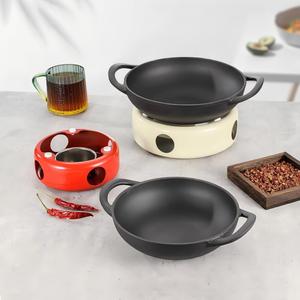
Commercial Cast-iron Wok Stir-fry Pan Two Handles Dry-pot Cookware Restaurant-specific Pot Alcohol-fueled Chinese-style Retro
Traditional Chinese dual-loop handle dry-pot cookware. Formulated with high-purity pig iron to withstand continuous open-flame, alcohol-burner, and wok-station operations.
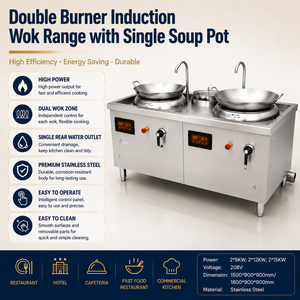
Commercial Wok Range for Restaurant Kitchens 2*12KW ETL Induction Cooker with Single Soup Pot
Heavy-duty 2x12KW commercial induction wok range. Features 3D concave German Inframax glass, IPX6 water-jet protection, and dual soup pot capacity for high-volume kitchens.
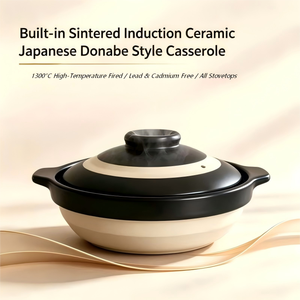
Japanese Style Handmade Ceramic Ceramic Pot Induction Commercial-Grade High-Temperature Resistant Durable Multiple Cookware Set
Formulated with spodumene-reinforced mineral ceramic clay. Withstands thermal shocks from -20°C to 650°C without cracking. Equipped with induction thermal bottom plating.
B2B Manufacturing Standards: Metallurgical & Structural Dynamics
For professional B2B procurement managers, sourcing high-performance Asian cookware such as the Traditional Kadai (Karahi), Commercial Stir-Fry Wok, and Multi-layer Stockpots requires rigorous metallurgical verification. Sourcing directly from top Chinese OEM/ODM factories provides undeniable cost-to-performance ratios when audited against standard ISO/NSF criteria.
The global demand for commercial-grade Kadais has expanded beyond South Asian and Middle Eastern traditional markets into mainstream global foodservice chains. A Kadai—characterized by its deep parabolic bowl design and dual riveted loop handles—serves as the primary thermal engine for deep frying, braising stews, reducing sauces, and high-heat stir frying. Selecting the appropriate structural metal grade dictates thermal efficiency, kitchen longevity, energy consumption, and food safety compliance.
| Cookware Material Grade | Thermal Conductivity | Tensile Strength | Induction Compatibility | Ideal Commercial Use-Case |
|---|---|---|---|---|
| Tri-Ply Clad (SS304-Alu-SS430) | 150 - 180 W/m·K (Aluminum Core) | ≥ 520 MPa | 100% (Magnetic 430 Base) | High-end commercial kitchens, heavy reduction, multi-stove lines. |
| Heavy Gauge Die-Cast Aluminum | 160 - 210 W/m·K | ≥ 240 MPa | Optional (Impact-Bonded Disk) | Non-stick rapid sauté, delicate sauces, low-fat institutional dining. |
| Commercial Carbon Steel / Cast Iron | 45 - 55 W/m·K | ≥ 350 MPa | 100% Native Magnetic | Ultra high-heat wok hei stir-frying, alcohol-burner dry-pots, sear stations. |
| Food-Grade AISI 201 Stainless Steel | 15 - 20 W/m·K | ≥ 650 MPa | Non-magnetic / Friction disk needed | Budget-conscious fast-food operations, high-durability deep frying. |
| Spodumene Ceramic Composite | 3 - 5 W/m·K (Thermal Storage) | ≥ 120 MPa (Flexural) | Requires Spray-Coated Metal Layer | Tabletop serving stews, slow-braised broths, aesthetic buffet displays. |
Note: Data aggregated from factory stress-testing laboratories and SGS metallurgical certification reports for standard 3.0mm wall thickness parameters.
Future Sourcing & Procurement Trends in Commercial Cookware
Navigating evolving international chemical regulations, energy efficiency mandates, and smart kitchen automation in global commercial cookware procurement.
1. Transition to PFAS/PFOA-Free Inorganic Coatings
With global environmental watchdogs (EU REACH, US EPA) tightening bans on fluorinated compounds, Chinese manufacturing hubs are leading the mass migration toward sol-gel ceramic coatings and thermal plasma nitriding, ensuring non-stick performance up to 450°C without toxic emissions.
2. Commercial Induction Synergy & High-KW Ranges
As gas-fire restrictions increase in indoor commercial complexes, wholesale buyers are demanding Kadais and woks specifically designed with 430 magnetic stainless bases capable of accepting continuous 12KW to 25KW high-frequency induction energy without base delamination.
3. Multi-Layer Cladding & Cold-Bond Metallurgy
Single-ply pots with brazed bottoms are being rapidly replaced by 3-ply and 5-ply seamless clad vessels. Cold-roll impact bonding eliminates hotspot scorching, reducing oil degradation by up to 30% and extending commercial frying oil life span.
4. Integrated Smart Sensors & Ergonomic Safety
Modern OEM buyers require built-in thermochromic visual safety rings and hollow stainless stay-cool handles with double-river structural reinforcement to reduce occupational injuries in high-velocity kitchen lines.
The Technical Evolution of Commercial Kadai Production
From labor-intensive hand-smithing to automated high-tonnage hydraulic deep-drawing and robotic multi-axis polishing lines.
Precision Engineering & Stamping Breakthroughs
Historically, commercial Kadais were forged from cast iron or hammered sheet metal, yielding inconsistent wall thickness and localized thermal failure points. Chinese manufacturing hubs have modernized this product category through state-of-the-art 2,500-ton hydraulic deep-drawing presses, producing single-piece seamless Kadai bodies with uniform metal density.
By eliminating welded side seams, modern Kadais eliminate mechanical stress points and bacterial traps. For heavy-duty restaurant applications, handle attachment zones utilize robotic dual-riveting or high-frequency capacitor discharge welding, withstanding tensile shear loads exceeding 4.5 kN without structural fatigue.
- Wall Thickness Consistency: Tolerances controlled to within ±0.05mm across the entire parabolic radius.
- Edge Finishing: Precision CNC straight-cut and rolled drip-free rims prevent liquid run-off.
- Surface Roughness ($R_a$): Electro-polished interiors achieving $R_a < 0.4 \mu m$ for rapid sanitation and non-stick release.
Core OEM/ODM Quality Control Protocol
Why Direct Sourcing from Leading China Exporters Drive Margin Superiority
Combining vast industrial manufacturing capacity, deep vertical integration, and world-class supply chain management to deliver unbeatable B2B value.
End-to-End Vertical Integration
Our manufacturing infrastructure spans raw aluminum smelting, stainless steel cold-rolling, precision die-casting, automated coating application, and final custom packaging. Eliminating middleman markups guarantees direct factory-floor pricing for wholesale buyers.
Rapid Tooling & Mold Development
Equipped with 5-axis CNC mold milling centers, our engineering teams convert CAD/STEP files into physical prototype samples within 15 calendar days, allowing private-label brand partners to launch custom cookwares ahead of market trends.
Global Regulatory & Compliance Guarantee
Every shipment is backed by comprehensive compliance documentation. Production lines adhere to ISO 9001:2015, ISO 14001, and BSCI social audits, while individual product lines carry NSF, ETL, FDA, and DGCCRF certifications required for North American and European import clearing.
Frequently Asked Questions (FAQ) for B2B Buyers
Detailed technical answers to common questions encountered by global procurement officers, distributors, and kitchenware brand owners.
Partner with China's Premier Cookware Exporter
Gain a distinct market advantage with high-durability products, direct factory pricing, and comprehensive OEM support tailored for international distributors and retail chains.