
Featured Wholesale Crepe Pans & Commercial Cookware
Engineered for thermal uniformity, high abrasion resistance, and seamless commercial kitchen integration.
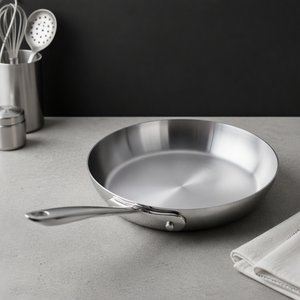
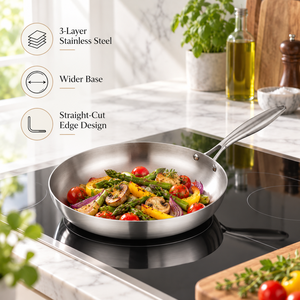
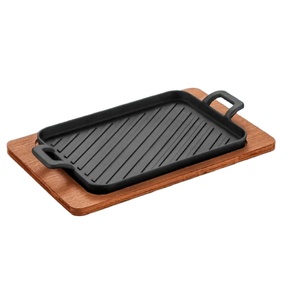
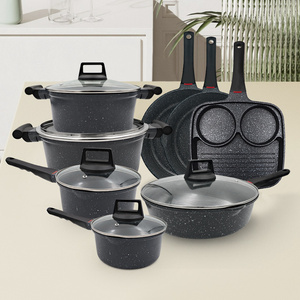
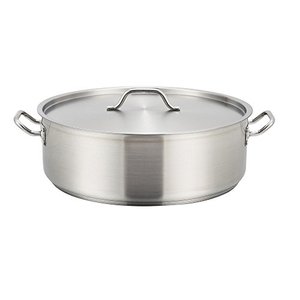
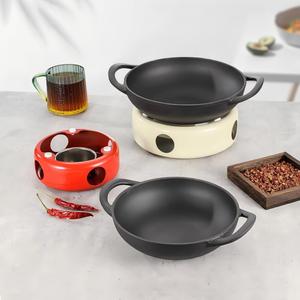
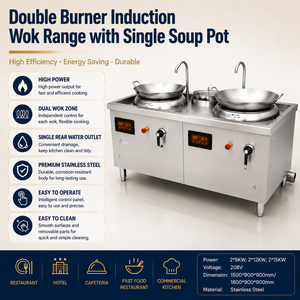
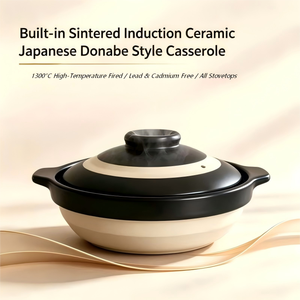
Engineering Excellence in Commercial Crepe Pan & Cookware Manufacturing
As a leading China Wholesale Crepe Pan Supplier, our manufacturing architecture is grounded in mechanical engineering, precision metallurgy, and surface chemistry. Crepe pans—traditionally recognized for their ultra-low sidewalls, wide flat cooking surface, and rapid thermal transfer requirements—represent a technical challenge in commercial cookware manufacturing. Unlike standard frying pans, a professional crepe skillet must guarantee structural planar stability across extreme thermal cycling without warping or developing central hot spots.
In high-volume commercial environments, such as French bistros, hotel breakfast buffets, and industrial bakery chains, cookware failure directly impacts operation margins. Our factory utilizes multi-stage cold forging and high-pressure die-casting technology to engineer aluminum and tri-ply stainless steel crepe pans that surpass international commercial standards (BS EN 12983-1 and NSF/ANSI Standard 51).
Substrate Analysis: Die-Cast Aluminum vs. Tri-Ply Stainless Steel vs. Cast Iron
When selecting inventory as a global distributor or private label enterprise, understanding the metallurgical performance metrics of each substrate is essential for aligning with your target market's cooking habits and energy sources.
| Material Substrate | Thermal Conductivity | Weight Distribution | Warp Resistance | Induction Efficiency | Best Commercial Application |
|---|---|---|---|---|---|
| Die-Cast Aluminum (ADC12) | 96 W/m·K (High) | Lightweight (850g - 1.1kg) | Superior (4.5mm Rim) | 92% (TIG Bonded Plate) | High-speed Creperies, Breakfast Buffets |
| Tri-Ply SS (304-Alu-430) | 45 W/m·K (Medium-High) | Moderate (1.2kg - 1.5kg) | Exceptional (Structural Clad) | 98% (Full Magnetic Base) | Fine Dining, Hotel Kitchens, Dishwasher Intensive |
| Commercial Cast Iron | 52 W/m·K (High Heat Retention) | Heavy (2.2kg - 3.5kg) | Indestructible | 95% (Direct Magnetic) | Traditional French Bistro, Steakhouse Grilling |
| 201 Stainless Steel (Single Layer) | 15 W/m·K (Low) | Lightweight (600g - 800g) | Moderate (Requires Capsule Bottom) | 88% (Friction Bonded) | Budget Institutional Catering, High-volume Retail |
Advanced Surface Coating Technology: PTFE vs. Sol-Gel Ceramic Formulations
The operational lifespan of a non-stick crepe pan is governed by coating hardness, substrate adhesion, and polymer cross-linking density. Our factory deploys automated Swiss-made 3-coat spray application lines in ISO Class 7 cleanroom environments to apply PFOA-free and PFAS-compliant non-stick systems.
Reinforced with titanium particles for extreme release properties. Achieves >45,000 cycles on the British Standard BS 7087 reciprocating abrasive pad test. Ideal for low-fat crepe sliding.
Inorganic silica-based coating resistant to temperatures up to 450°C. 9H pencil hardness scale rating prevents surface scratching from wooden T-spreaders and spatulas.
100% natural soy-based oil baked at 400°C to create a hydrophobic polymerized oil layer. Develops superior non-stick properties over time without chemical degradation.
Global Sourcing & Procurement Trends for Commercial Cookware (2025–2030)
As international supply chains evolve and environmental legislation tightens in North America and Western Europe, procurement officers must adapt their sourcing strategies. Below are key macroeconomic and technical trends shaping the commercial cookware import landscape over the next five years:
Driven by kitchen decarbonization policies, commercial kitchens are rapidly ditching open-flame gas ranges for high-power induction cooktops (such as 12KW commercial induction wok units). Sourcing demands crepe pans with 100% full-surface magnetic bottom coverage.
With EU REACH regulations and US state-level bans (e.g., California AB 1200) coming into full effect, major retail buyers require verifiable laboratory test reports confirming zero PTFE, PFOA, PFOS, Lead, and Cadmium leaching.
Long commercial shifts demand lightweight stainless steel hollow cast handles or heat-resistant silicone sleeves. Riveted construction remains mandatory for NSF-grade commercial safety, eliminating screw-loosening risks.
To support high-volume buyers, our facility provides complete supply chain transparency, container load optimization (CBM maximization), and eco-friendly recyclable packaging solutions, reducing freight cost per unit by up to 14%.
Why Partner With Us: Direct Factory Capacity & Quality Management
Founded in 1990, our manufacturing facility has expanded into a flagship enterprise occupying over 150,000 square meters of automated manufacturing infrastructure. As Bangladesh and China’s leading kitchenware exporter, we operate integrated tool-making, alloy die-casting, surface treatment, and electric appliance assembly plants under one roof.
Our commitment to quality is validated by international compliance standards, holding ISO9001:2015 quality management systems certification, ISO14001 environmental management certification, along with product-specific approvals including NSF, ETL, CE, LFGB, and FDA approvals.
In-house CNC mold engineering team capable of developing custom crepe pan dimensions, custom bottom embossing, and specialized handle ergonomics within 21 business days.
Every batch undergoes stringent quality audits: coating adhesion cross-hatch testing, thermal shock endurance (-20°C to 280°C), salt spray corrosion analysis, and handle tensile strength tests.
Extensive experience shipping FCL/LCL orders to over 60 countries across North America, Europe, the Middle East, and Southeast Asia with flexible Incoterms (FOB, CIF, DDP).
Ready to OEM Your Private Label Crepe Pan Line?
Contact our engineering sales team today for factory-direct wholesale pricing, technical CAD drawings, and low-MOQ sample evaluation kits.
Frequently Asked Questions (FAQ) for B2B Buyers
Clear answers to technical, commercial, and logistical questions regarding crepe pan wholesale procurement.
For commercial heavy-duty applications, a base thickness between 3.5mm and 4.5mm in die-cast aluminum is optimal. This thickness prevents thermal warping under continuous kitchen use while guaranteeing edge-to-edge heat distribution required for paper-thin crepe cooking.
Yes, all our non-stick coatings—including multi-layer PTFE, diamond-reinforced, and sol-gel ceramic options—are 100% PFOA-free, Heavy Metal-free, and fully certified under US FDA 21 CFR 175.300 and European LFGB standards.
Our standard MOQ for OEM private-label crepe pans ranges from 1,000 to 2,000 pieces per size for customized colors or handle logo laser engraving. For standard running stock items, smaller trial order quantities (MOQ 500 pcs) can be accommodated.
Absolutely. We apply thermal-impact bonded 430 stainless steel induction discs to the bottom of our aluminum crepe pans. This enables full compatibility with commercial induction ranges, gas burners, ceramic cooktops, and electric plates.
We strongly recommend heavy-duty stainless steel dual-riveted handles for commercial food service orders. Riveted joints offer superior mechanical shear resistance compared to welded or single-screw designs, ensuring safety in busy commercial kitchens.
We execute ISO-standard AQL 1.5 Major / 4.0 Minor inspection procedures. Every shipment undergoes dimensional verification, coating thickness gauge tests, dry film adhesion tests (cross-hatch method), heat transfer uniformity checks, and drop packaging tests.
Standard production lead time for a 40ft High Cube container (approx. 8,000–12,000 units depending on packaging) is 30 to 40 days following sample sign-off and deposit receipt. Repeat orders can be expedited to 25 days.
Yes. We provide prototype and pre-production samples within 7-10 business days. Sample costs are fully refundable upon placement of the formal container purchase order.