1. Advanced Metallurgical Engineering in Modern Dosa Tawa Manufacturing
The global culinary equipment market has experienced a decisive structural shift. Sourcing managers and brand owners no longer evaluate flat cookware—specifically the specialized Dosa Tawa and crepe pan category—solely on basic non-stick functionality. Today’s purchasing decisions hinge on core metallurgical integrity, thermal kinetics, warping resistance under high BTU loads, and compliance with stringent international chemical contact safety standards (including US FDA 21 CFR 175.300 and EU LFGB Regulation EC 1935/2004).
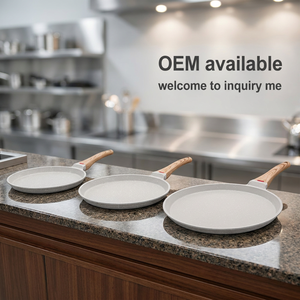
As China’s leading high-volume Dosa Tawa manufacturer and exporter, our engineering facilities utilize four primary structural foundations to serve diverse price points and performance expectations across North America, Europe, the Middle East, and South Asia:
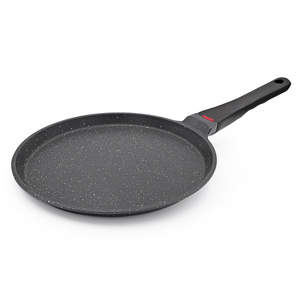
- High-Pressure Die-Cast Aluminum (ADC12 Alloy): Formed using 1,200-ton to 2,500-ton automated cold-chamber die-casting presses. This process allows variable wall-to-base thickness ratios (e.g., 4.5mm heavy thermal base tapering to 2.2mm structural rim). The liquid metal density eliminates micro-porosity, guaranteeing superior heat retention and structural anti-warping properties up to 400°C.
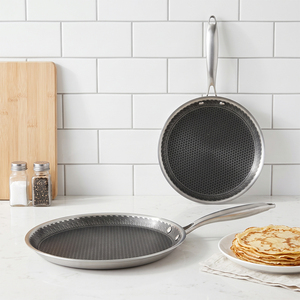
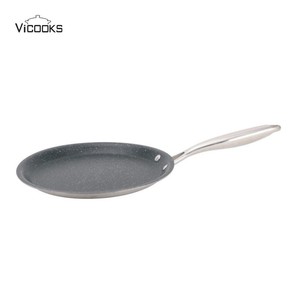
- Tri-Ply Clad Stainless Steel (SS304 / Pure Aluminum 1050 / SS430): A multi-layered bonded composite. The food-contact layer is non-reactive AISI 304 stainless steel; the inner core is high-purity 1050 aluminum (thermal conductivity ~229 W/m·K) for rapid lateral heat dispersion; the exterior is magnetic AISI 430 stainless steel, ensuring instant energy transfer on high-frequency commercial induction hobs.
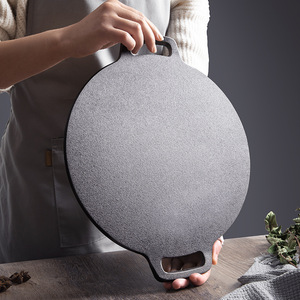
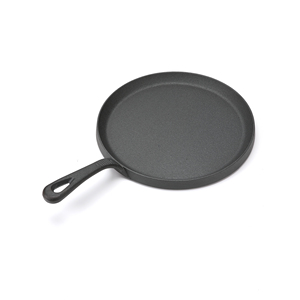
- High-Density Pre-Seasoned Gray Cast Iron (ASTM A48 Class 30): Engineered for authentic traditional crisping. Featuring high volumetric heat capacity, cast iron tawas absorb immense thermal energy, preventing localized temperature drops when cold batter is spread over the cooking surface.
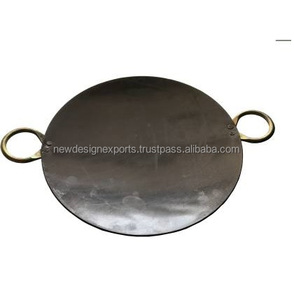
- Heavy-Gauge Commercial Sheet Metal / Carbon Steel: Ranging from 4.0mm to 10.0mm in thickness, designed primarily for high-capacity street food operations, commercial catering, and restaurant installations requiring continuous thermal endurance.
| Material Substrate |
Thermal Conductivity |
Warp Resistance (BTU Load) |
Induction Efficiency |
Target B2B Market Segment |
| Die-Cast Aluminum (ADC12) |
160 - 180 W/m·K |
Exceptional (Variable Thickness) |
High (Impact-Bonded Steel Disc) |
Mid-to-High Retail & Premium Cookware Brands |
| Tri-Ply Clad Steel |
210 - 230 W/m·K |
Superior (3-Layer Bonded) |
Native Direct Magnetization |
Professional Culinary & Luxury OEM Lines |
| Pre-Seasoned Cast Iron |
50 - 55 W/m·K |
Absolute Immunity |
High (Ferromagnetic Material) |
Traditional Specialty & Heritage Retailers |
| Commercial Carbon Sheet |
60 - 70 W/m·K |
High (Heavy Gauge Sheet) |
High (Gas & Flat Commercial Induction) |
Restaurant Equipment & Wholesale Catering Supply |
2. Next-Generation Surface Engineering: PTFE, Granite & PFAS-Free Sol-Gel Ceramics
The surface coating on a Dosa Tawa dictates both its culinary performance and market compliance. Fermented rice-and-lentil batter requires instantaneous releasing properties combined with high surface abrasion resistance, as metal or wooden spatulas are frequently employed during commercial and domestic preparation.
Our manufacturing engineering department specializes in three primary surface treatment technologies designed to optimize longevity, non-stick release coefficients, and consumer safety:
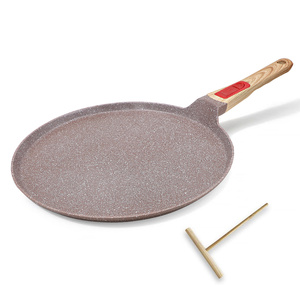
A. Reinforced Multi-Layer PTFE Granite System: Formulated with inorganic mineral particles (granite or titanium micro-crystals) embedded within a 3-coat or 4-coat fluoropolymer matrix. This creates a textured micro-surface that drastically reduces friction while elevating scratch resistance to over 20,000 cycles under standard BS 7069 wet-abrasion testing protocols.
B. PFAS-Free Sol-Gel Ceramic Coatings: Driven by tightening global regulations (including EU REACH restrictions and US State-level PFAS bans), our inorganic silica-based Sol-Gel ceramic coatings provide an ultra-hard surface (up to 9H Pencil Hardness). Cured at lower thermal thresholds (around 300°C), ceramic coatings deliver zero PFOA, PTFE, Lead, or Cadmium emissions, operating safely up to 450°C without thermal degradation.
C. Laser Micro-Honeycomb Etching Technology: Applied predominantly to 3-ply stainless steel tawas. Precision laser fiber machines etch a hexagonal raised stainless steel grid above the recessed non-stick valleys. The raised steel ridges bear the physical impact of metal spatulas, preserving the underlying non-stick coating and extending operational pan lifespan by up to 400% compared to traditional flat coated pans.
3. Global B2B Procurement & Sourcing Forecast (2025–2030)
As a global export hub supplying over 30,000 retail and wholesale channels across 50+ countries, our market intelligence division tracks macro sourcing shifts. Enterprise buyers preparing product roadmaps for 2025–2030 must align their supply chains with four decisive industry developments:
- Universal Induction Base Standardisation: Market demand for gas-only flat tawas is contracting rapidly. Overseas buyers are prioritizing full-coverage perforated or solid stainless steel induction bottom plates (0.5mm to 1.2mm thick magnetic flux discs). Our cold-impact bonding technology ensures zero plate detachment under rapid thermal shocks from 250°C to 20°C water immersion.
- Thermochromic & Smart Ergonomic Handles: Temperature-sensitive silicone rings integrated into the handle neck change color (e.g., changing from dark red to bright pink at 180°C), providing visual thermal feedback to home cooks. This feature drastically reduces thermal oil burning and improves safety profiles for e-commerce and retail brands.
- Modular Space-Saving Packaging (Detachable Handle Systems): High international ocean freight rates have pushed retailers toward flat-pack logistics. Our patented single-click removable handle mechanisms allow Dosa Tawas to stack flat in color packaging, reducing master carton CBM volume by up to 38% and lowering landed freight cost per unit.
- Transition to 100% Recycled Aluminum Alloys: Carbon-footprint audit demands from European and North American importers have led our foundry to offer certified 100% post-consumer recycled aluminum ingots. This maintains identical yield strength and thermal conductivity while reducing embodied manufacturing carbon emissions by 75%.
Enterprise Manufacturing Strength & Global Supply Network
Building on over 34 years of industrial cookware manufacturing heritage (since 1990), our operational infrastructure encompasses dual high-capacity manufacturing complexes spanning over 150,000 square meters of dedicated production space. Supported by a workforce of over 3,500 dedicated engineers, metallurgists, die-casting technicians, and quality inspectors, our annual output exceeds 15 million cookware units globally.
As a certified supplier operating under ISO 9001:2015 quality management and BSCI social compliance protocols, we serve tier-one department store chains, multinational brand owners, direct-to-consumer e-commerce leaders, and commercial restaurant supply wholesalers across North America, Europe, the Middle East, South Asia, and Latin America.
Whether you require high-volume OEM manufacturing of budget-friendly non-stick roti tawas or high-end ODM development of laser-etched tri-ply stainless steel crepe griddles, our engineering team provides end-to-end support—from initial CAD/CAM modeling and thermal prototyping to custom packaging artwork and international sea freight logistics.